Wednesday, January 26, 2011

Here We Go: More Snow!

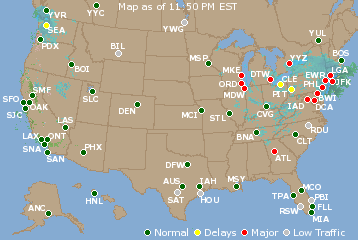
[Airport delays at 7.35 p.m. EST tonight. Tomorrow will be worse. Map via FlightView.com].

Oh, you know. More snow. Hundreds of flight cancellations in the Northeast. Worse tomorrow.

Et cetera.

###

Friday, January 21, 2011

Armed in Tucson

[Photo: A javelina]

TUCSON -- My favorite New York Times columnist is Tim Egan, and his column about guns and Tucson is the best I have read on that subject since that lunatic went on his shooting rampage Jan. 8.

The Egan column today, which is online, is headlined "Myth of the Hero Gunslinger." Egan describes himself as a third-generation Westerner who grew up among guns and "Second Amendment enthusiasts who wore camouflage nine months out of the year," as he writes, adding: "Generally, I don’t have a problem with any of that."

As an adoptive Westerner who has had a home in Tucson for more than five years and has lived here full time for over a year, I've been interested in the general media take on guns because it's axiomatic that many law-abiding citizens here are armed, even if they aren't packing -- that is, carrying a concealed weapon.

I was amused by the outside-media take on the Crossroads of the West Gun Show that was held on the county fairgrounds last weekend, a week after the shootings. I went to the gun show just to get a sense of it. Coming out, I was amazed by the number of out-of-town reporters (the TV types are the ones who you can identify, of course) who were so obviously looking for irony, and so clearly failing to get it.

That is, it was apparent to me that they were looking for wild-eyed gun nuts having themselves a wallow in the ammo a week after the massacre. A woman with a camera crew who said she was from ABC waylaid me on my way out. She was the only one there who looked wild-eyed, by the way.

"What'd you get?" she said, eyeing my plastic bag, which I could tell she assumed contained 31-shot magazines and maybe a new Glock.

I told her I was a reporter and moved along. Actually in the bag was a new $12 wallet, purchased from a guy inside who also sold ladies' purses designed to hold pistols. Oh, and also a $6 container of pepper-spray, bought on impulse and for the reason that my property in Tucson often plays unwilling host to a wandering herd of javelina.

Pepper spray, I had thought, would be a good backup to have in case one of the nasty, wild-pig-like javelinas charged me as I tried to shoo them off -- as has happened.

My wife did not agree. "Get that stuff out of the house. You'll blind somebody," she told me when I got back.

Actually, javelinas, though dangerous when in a panic, are stupid and very nearsighted. The one time a javelina charged me out back, just a month ago, he ran straight into a wood lawn chair and it knocked him over. Snorting, he cantered off in frightened bewilderment. Pepper spray would have been beside the point.

As to the matter of guns and potential assaults, people here are pretty sensible (aside from the violent paranoid schizophrenics, who everyone agrees should not be allowed to own a gun). I know that many of my neighbors out here in horse country on the East Side of town are armed.

Before we moved here full time in late 2009, I had been coming out to the house regularly from our home in New Jersey, sometimes for a month or more to work on a book. In my absence, one neighbor -- whose house we can barely see from ours -- kept an eye on our place.

I think I won his trust when I told him one night before leaving, "You see anything that needs shootin' over here, go ahead and shoot it."

That was a joke, which you could make before that awful shooting on Jan. 8.

And by the way, while many neighbors out this way seem to be armed, any one of them that I have ever had a conversation with about guns (I myself don't own one) has stressed 1. The absolute necessity of getting good gun-safety and gun-procedures training before you acquire a firearm and 2. The reality that any time you use or even display a gun in a situation you consider to be hostile or threatening, you will at least be having a subsequent conversation with a police officer or, worse, with a lawyer defending you in court.

Not long ago, we had a workman come in to refinish our polished concrete floors. The second day on the job he arrived four hours late. He looked pale and shaken. A legal Mexican immigrant who lives in the crime-troubled neighborhood of South Tucson, he explained that in the middle of the previous night, three armed intruders had broken into his house, evidently having mistaken the address for one occupied by drug dealers nearby. He, his wife and their two young children had been rousted out of bed and held at gunpoint for over an hour, while the intruders ransacked the house.

"Did you have a gun?" I asked him. No, he said. "If I had a gun, my wife and my children would now be dead, and me too," he said.

After the Tucson shooting, a lot of the usual national right-wing clowns bellowed and brayed about how the rampage could have been halted by a bystander with a gun.

Now, Tucson having a culture that is not all that far removed from the actual Old West, it was a given that a certain number of bystanders would be armed when Jared Loughner put a bullet in the head of Congresswoman Giffords, and then began picking off the other victims, one by one, rapid-fire, till 19 in all had been shot, six shot dead.

"When everyone is carrying a firearm, nobody is going to be a victim," said Arizona state representative Jack Harper," as quoted in the Egan column.

As anybody who has carried a gun in actively dangerous situation knows (and I carried one for a year in Vietnam), this is a foolish statement. Gunfire often breaks out without the slightest warning and in great, great fury and confusion. Bullets, as they say, fly.

Naturally, some law-abiding people at the scene of the shooting were carrying guns. Egan and others have pointed to one bystander, Joseph Zamudio, who was legally carrying a 9-millimeter semiautomatic pistol. With his gun, he rushed toward the shooting commotion -- and almost shot an innocent man who he initially thought was the assailant.

Zamudio held his fire because people were yelling that he was about to shot the wrong man. The shooter himself was actually knocked down by a man using a folding chair as he tried to reload, and then pounced on and subdued by other citizens who wrestled the pistol and a spare magazine from him.

Anyway, let me give you my notes, my less-than-scintillating report on the gun show in Tucson last week that failed to deliver the delicious irony that some of the media I encountered there were so obviously expecting:

--About 1,500 people had entered by 10 a.m. (doors opened at 9). Crossroads of the West Gun show at sprawling Pima County fairgrounds in Southeast Tuscon. This is a traveling gun show.

--All was contained in a big exhibition hall, where vendors had set up many rows of tables, and crowds wandered by. All kinds of guns and ammo, including some automatic weapons - but also things like survival gear, knives, high-performance hunting gear like flashlights and binoculars and scopes, bulletproof vests, leather goods (including womens purses made to hold concealed weapons).

--Some people brought little kids, including some babies. Mostly men, but some women too.

--Typical Tucson: friendly, cordial atmosphere. No belligerence apparent anywhere, "please and thank you and excuse me" all around. Even the bumper stickers and other signs were low-key, mostly in support of gun rights, military, etc. NRA presence obvious of course.

--One guy was wearing a tee-shirt that said: "I carry a gun because a cop is too heavy."

--Quote: "People here are all pretty nice. There are very few buttheads," Tom Colaric, a dealer in leather products at a display table where I bought my $12 wallet.

--One woman had a big big display of very fine, expensive Czech crystal: expensive cut-glass wine and whiskey glasses and decanters, and even glass Christmas ornaments. Her name: Jarmila Kovary, of Phoenix. She said she does a good business at gun shows because "more women have been coming to these things and people here come with money to spend."

One guy walking by said, "Nice wine glasses." And a guy with an NRA hat who was standing nearby said, "--for target practice." Jarmila Kovary seemed horrified at that.

--Outside the entrance to the hall, where a long line of people had queued to buy tickets by 10 a.m., there was a plexiglass hopper with this sign on front: "Tragedy in Tucson Victims Fund" It had what I guessed was about $50 in it, in dollar bills and some fives.

A guy standing beside it had just purchased a revolver and was spinning the chamber appreciatively in the sunlight. Then he snapped it shut and dropped a dollar into the donation box.

As the man at the leather goods display said, "Very few buttheads."

###

Monday, January 17, 2011

Crazy in Tucson

How inconvenient for the pious revisionists wagging their fingers and tongues at those who see an obvious link between violent political rhetoric and the attempted assassination last week of Rep. Gabrielle Giffords. How inconvenient that Ms. Giffords herself drew that link between hate-agitation and potential violence.

All week, sentinels of Approved Wisdom have been at it, trying to crank the mighty narrative machine to the safe position that the Tucson shootings were solely the work of a lunatic, nothing more. After all, goes the claim, there is no direct evidence that this Jared Loughner, who everybody agrees is crazy, acted in any way that indicated political motivation.

Uh, except that with premeditation, he shot in the head a United States congresswoman who has long been the target of nasty, vile hate directed at her by national, and less often local, elements of this amorphous Tea Party movement.

But again, how inconvenient to this argument that Gabby Giffords, who happens to be my congresswoman, herself had expressed grave concern about the barely disguised violent threats being made against Democratic congressional candidates, not just herself but many others, during the last election campaign.

I'm referring partly to the infamous online political ads backed by the invincibly awful Sarah Palin, a woman who imbues the old-fashioned word "grifter" with new vitality. The most notorious of these ads appeared last March and depicted a map of the United States with bulls-eyes imposed over those congressional districts that the most rabid elements of the Tea Party had deemed, with Palin acquiescence, to be metaphorical targets. Accompanying this particular Palin abomination was her battle-cry "Reload!"

Now, no one has ever accused Gabby Giffords of being a sissy. No one has ever accused her of being a gun-hater, either.

In fact, Giffords owns and knows how to use a Glock semiautomatic pistol, just like the one Jared Loughner used on his Tucson rampage to shoot her in the head, kill six people and wound a dozen others. Giffords is a well-known supporter of gun-ownership rights. But she was also sufficiently motivated by the vile Palin ad, in an atmosphere of very nasty vitriol, to express her concern in an interview with MSNBC during the campaign.

The Palin ad, Giffords noted, put "the crosshairs of a gun-sight over our district." Those who do things like this, or who talk like the awful Sharron Angle, the Nevada senate candidate who referred merrily to seeking "Second Amendment remedies" when civil politics fail, "they've got to realize there's consequences to that action," Giffords said.

Yes, yes, there were. As we saw in Tucson.

Around the same time Gabby Giffords was discussing the gun-sights on her, someone shattered a window in her campaign headquarters in the dead of night.

It is of course clear to everyone that the young man who shot Gabby Giffords and those 18 other people in Tucson is crazy. The act was, by its very definition, crazy. I do not require the consensus of a blue-ribbon panel of learned psychiatrists to confirm for me that this Loughner is an obvious, violent paranoid schizophrenic. After all, we have been this way before.

Crazy people by definition do crazy things. But when a lunatic, acting out on a premeditated plan that is rational by definition, tries to assassinate a political candidate in an intense atmosphere of reckless political hate-rhetoric directed against that candidate -- that connection, to me, is not disputable.

Take Lee Harvey Oswald. To this day, there is no direct evidence that Oswald acted out politically when he decided to assassinate President Kennedy. Yet he did act (and conspiracy theorists aside, we know for a fact that Oswald had that rifle, that he took that rifle to the Texas Book Depository, that he hid on the 6th floor of that building, that he fired that rifle at the presidential motorcade passing below) in an atmosphere in Dallas of virulent, violent anti-Kennedy hatred. That hatred was assiduously fanned by right-wing nut jobs, the most prominent of whom was the crackpot oil billionaire H.L. Hunt. So nasty was the atmosphere in Dallas back then that Kennedy was warned, including by people like Adlai Stevenson, not to go there that day.

Yet he did, and he was shot to death.

When I heard of the shootings in Tuscon, I rushed over to the Giffords campaign office on the busy corner of Pima and Swan in central (not downtown) Tucson. This is the office where the window-smashing (or shooting, the police aren't sure) vandalism had occurred during the heat of the campaign last March.

Within an hour after the shootings, about 50 Giffords supporters, many of whom knew her personally and had volunteered in her campaigns, were gathered quietly on the corner in front of the office. Out back in the parking lot, some listened tearfully to conflicting reports blaring from NPR on a car radio about whether Giffords was dead or not.

During the campaign and even afterward, they told me, noisy political-opposition demonstrations were regular occurrences there on Saturdays. The Giffords district office is about a block south of the modest condominium complex where Giffords lives when she is in town, which was nearly every weekend. Typically, I was told, hundreds of Tea Party anti-Giffords demonstrators gathered on Saturdays on three of the four corners of the intersection of Pima and Swan, and a much smaller group of supporters usually gathered on the fourth corner.

This being Tucson, a city of enormous civility, the Tea Party demonstrations were usually lower-key than some Tea Party mob scenes elsewhere. But some ugly signs with clearly violent messages were often on display, and ugly chants were common. (Local Tea Party people, who also tend to be civil, lay this bad behavior to out-of-towners, incidentally, and I don't doubt them on that).

One recurring theme was the depiction of Giffords, an indomitably cheerful, pretty young woman who was widely liked in her district even by people who wouldn't vote for her, as a witch flying away on a broomstick. One sign that especially bothered the Giffords supporters showed a silhouette of a witch with the message: "Gabby: One Way Or Another, You're Gone."

This was the crazy atmosphere in which a crazy person began the descent that would lead him to act, with clear intent, to assassinate Congresswoman Giffords.

Surely, mental-health spending must be increased. But not so fast. Let's give that one some rational thought about just where that spending is going, because it sure as hell hasn't been going into protecting society from the likes of Loughner.

At the vigil outside the Giffords office on the day of the shooting I noticed one more thing. Within hours of the shooting, a small contingent of Red Cross mental-health crisis workers arrived. They were there, one of them told me, "to assist the emotionally wounded."

Now, I spoke with most of the people on the corner that Saturday and the next day as well, and while all of them were shocked and horrified and sad, none of them described themselves as being in need of mental-health intervention.

And there's a rub.

In 1994, a book of mine was published by St. Martin's Press, "Bedlam: Greed, Profiteering and Fraud in a Mental Health System Gone Crazy." The book has long been out of print.

Bedlam was written at a time when for-profit corporations had been rapaciously pillaging the mental-health insurance system, because a large amount of insurance money had become available for the treatment of "mental disorders," as defined by the growing psychiatric and addiction industries. Despite its myriad deficiencies, Bedlam did trenchantly describe how this system worked.

Back in the 1960s and 1970s, hugely expensive state hospital mental asylums were closed, and their patients released onto the streets, in a phenomenon called deinstitutionalization.

In exchange for closing down the tax-draining state hospitals, the plan was that an efficient network of community mental-health centers (including crisis centers) would be developed all over the country to treat serious mental illness, rather than merely confining the seriously mentally ill to those dreadful state institutions.

Lots of insurance money poured into mental-health services, partly as a result of lobbying by various interest groups.

But the promise of community mental-health networks for the seriously ill was broken. Instead, the money was diverted into insurance coverage for a rapidly growing industry dominated by for-profit hospitals and paid-for psychiatrists who were hired to essentially bid-rig diagnoses. The purpose was to channel new patients into the system, where their insurance coverage could be profitably and thoroughly milked, even if it meant "diagnosis-flipping" -- that is, certifying a new diagnosis code when the insurance-reimbursement allocation for the old one ran out. Essential to that scheme was a vast increase in the number of behaviors that could be classified and coded, for insurance-reimbursement purposes, as mental illnesses.

Our mental-health system became fully medicalized. And one scandalous upshot of that phenomenon was that the really seriously mentally ill got left out of the equation. After all, treating the seriously crazy is frustrating and not profitable. Instead, starting in the 1970s, we started seeing people who really needed psychiatric intervention on the street, and we were conditioned to think of them instead as being among the "homeless."

The central fact about our mental-health system (and the caution to be exercised amid calls to fund more mental-health services) is this: It is not designed to treat serious mental illness in any serious manner.

Oh, how I wish I could ask Jared Loughner's mother and father: How did you try to get appropriate mental-health treatment for this sick boy (because I am pretty sure that you did)? What were you told when they turned you away? How deep was the frustration and misery suffered by you and the other families of seriously mentally ill people who have nowhere to turn?

There is no money to be made from the chronic paranoid schizophrenic, the violent psychotic. The truly crazy have no constituency besides their families, assuming they have families. While decent counseling is often available for those facing debilitating life crises (who have insurance, that is), most mental-health resources flow into treatment of what has long been known among honest psychiatrists and psychologists as the "worried well." As Willie Sutton said, that's where the money is.

I heard some woman on NPR last week whining about how she was seeking mental-health counseling because she was so emotionally distressed by the Tucson shootings -- which she had not even witnessed or been directly affected by. She was treated with gentle reverence on the radio. Yes, precious mental-health resources will flow her way.

Our mental-health system is broken. And it's a lot more systematically corrupt than our political system.

Serious, severe mental illness like that exhibited for a long time by Jared Loughner goes untreated, or more to the point unsupervised, because the system is designed mainly to make money.

We need to understand that better, in a society where even the crazy people are armed.

###

Wednesday, January 12, 2011

Air Travel Advice in East: Stay Home

Another fine mess in the Northeast this morning as a snowstorm arrived.

The by-now-usual grim tales unfold, including very large numbers of cancellations. As of 9 a.m. EST, according to FlightStats.com:

At the hilariously named Newark Liberty International Airport, 300 departures and 244 arrivals have been canceled so far. At La Guardia: 365 and 313. JFK: 325-255. Boston: 379-325. Philadelphia: 130-128. Reagan: 109-104. BWI: 57-55. Dulles: 46-52.

That adds up to about 5,400 canceled flights at those airports alone(some of the departures and arrivals are overlaps but not all that many in this geographical area.)

Meanwhile, Atlanta Hartsfield is still struggling after that city got whacked by ice and snow days ago, causing more than 5,000 flight cancellations: This morning at Atlanta, another 190 departures and 255 arrivals have been scrubbed. Chicago O'Hare and other major airports are also racking up big cancellation numbers.

And delays, forget about it. At Newark, the flights that remain scheduled are averaging 4 hour departure delays. At La Guardia, it's 3 hours and 45 minutes. Boston and JFK also are reporting delays in excess of 3 hours and 30 minutes.

Florida is the only state in the country that doesn't have any snow right now, the National Weather Service says. (Yeah, I know, you're thinking, What about Hawaii? But remember, there's snow on Mauna Kea as well as Mauna Loa.)

Alone in its snowless condition, Florida still feels the ripple effects, with all of the major airports reporting big delays. Orlando is also seeing flight cancellations: 43 departures and 61 arrivals canceled so far this morning in a ripple effect from the Northeast weather.

###

Tuesday, January 11, 2011

Near Gridlock in Air Travel

[Map: Flightview.com]

This is what the airports looked like a little before midnight today. And it's going to be a lot worse tomorrow morning.

###

Tarmac Delays in November: Zero. Again.


Again in November there were no tarmac delays of over three hours on domestic flights, the Transportation Department's Bureau of Transportation Statistics reports this morning.

In the chart above, you can see how these so-called tarmac strandings have dropped since April, when the Transportation Department imposed a policy that can fine airlines up to $27,500 per passenger for stranding planes on tarmacs.

###

Airlines Preemptively Canceling Flights in New York Area

Under threat of snow, airlines are preemptively canceling flights at the three New York-area airports for both today and tomorrow.

To me, this looks like a test of the assertion that airlines would cancel a larger than normal number of flights with bad weather merely forecast, rather than raging, to underscore their opposition to the Transportation Department rule that imposes severe fines on carriers for stranding passengers on tarmacs for over three hours. The rule has effectively ended so-called tarmac strandings for domestic carriers (international carriers are not covered by the rule, and have been responsible for several egregiously lengthy strandings in recent snowstorms).

On the other hand, airlines do routinely cancel some flights preparation for seriously bad weather so that x-number of airplanes and crews are not frozen in place if bad weather does hit.

As of 9 a.m. EST today at the hilariously named Newark Liberty International Airport, 216 flights have been canceled -- and 145 flights scheduled for tomorrow have also been scrubbed. At Kennedy, it's 101 today and 97 tomorrow. La Guardia: 172 today and 114 tomorrow.

Data as usual from FlightStats.com

###

Monday, January 10, 2011

Nearly All Flights in Atlanta Canceled; Cancellations Also Mounting for Tuesday As Big Storm Heads Toward New York

[UPDATED]
Atlanta Hartsfield International Airport, the busiest airport in the country in terms of flights handled, is virtually shut today as ice and snow hit the city. As of 6 p.m. EST, 2,211 of today's 2,570 flights have been canceled.

And tomorrow is also grim: Already, about 900 departures and arrivals have been canceled at Atlanta.

Cancellations are also hitting other airports. At Charlotte, 527 flights had been scrubbed by late afternoon. (Data from FlightStats.com)

The storm is expected to hit the New York area starting early Tuesday night, with snow accumulations of 10 or more inches possible. Right now, the New York airports are operating with delays, partly as a result of the Atlanta mess, but only the hilariously named Newark Liberty International airport is reporting cancellations, in this case about 70.

AirTran canceled all of its Atlanta flights. The airlines canceling the most flights in Atlanta are Delta, Atlantic Southeast Airlines, which operates Delta Connection flights, and AirTran, which Southwest is in the process of acquiring.

Because of the large number of regional connecting flights it handles as a hub in the Southeast, Atlanta is the busiest airport in the country. (In fact, it's the busiest airport in the world in terms of the number of flights it handles).

In Atlanta, even MARTA has shut down, canceling all bus service today and maybe tomorrow too.

Meanwhile, the Loews hotel chain has said that it is offering a special rate of $139 a night at its new Loews Atlanta hotel through Wednesday. Passengers stranded in Atlanta might want to take note.

###

Atlanta Cancellations As of 9 A.M: 2,550

There have been 2,550 flights canceled in Atlanta as of 9 a.m.
###

[Newspapers used to pad out columns of type inside the paper that were a few lines short with trivial fillers of information. One I remember in particular from the defunct Philadelphia Bulletin when I worked there in the late 70s had the headline: No Blood in Ants over a story that consisted entirely of this sentence: Ants have no blood.
]
###

Sunday, January 09, 2011

Heads-Up: Cancellations Mount in Atlanta

Snowy weather equals massive flight cancellations these days, and Atlanta is racking them up: 350 today and, hang on, 1,650 flights canceled already for tomorrow.

###

Saturday, January 08, 2011

Democratic Congresswoman Shot in Tucson

Gabrielle Giffords, the liberal Democratic congresswoman from Tucson, has just been shot in Tucson. Details developing.

###

Friday, January 07, 2011

Row 44 WiFi in Another Advance for Service on International Flights

The aggressively expanding inflight WiFi provider Row 44 said today that it received approval from the Federal Communications Commission to offer its satellite-based broadband service in flights over the Atlantic.

The FCC issued Row 44 a license for the T11N North Atlantic Oceanic Coverage satellite. This makes Row 44 the only provider allowed to operate and charge for inflight broadband connectivity on transatlantic flights.

In the U.S., Aircell's Gogo system -- which is based on land antennas and can't operate over oceans -- is the leading inflight Internet provider, with service operating on more than 1,044 mainline domestic planes of seven U.S. various airlines, Delta being the leading one, and on Air Canada.

Row 44 is now installing its system on Southwest's entire fleet of 737s, and has been in trials with other airlines.

The next expansion is international, obviously, though there is already robust competition from foreign companies on airplanes operating in Europe and elsewhere.

"This license creates complete seamlessness for Row 44’s broadband across the Atlantic," said Howard Lefkowitz, Row 44’s chief commercial officer. "Row 44 is now the only company in the world whose airline customers can charge for in-flight broadband on, say, a transatlantic flight from Paris to New York."

On Wednesday, Row 44, had said it received a so-called Supplemental Type Certificate (STC) from the European Aviation Safety Agency to install its system on commercial aircraft in Europe. The certificate cleared a big hurdle for the company in its plans to sell its service to European airlines.

Row 44 says it is authorized for operation in over 100 countries, on four continents. The company’s current network coverage includes service over the US, Mexico and Canada, with transatlantic coverage linking North America and Europe expected this year.

###

A Hint of Snow, and Hundreds of Flights Canceled in New York

Hey, it's winter. It snows sometimes in New York, so let's not get all hysterical about it, airlines and government and, of course, media.

Anyway, it was snowing in New York -- the forecast was for maybe four inches, tops. [UPDATE -- Mid-afternoon, only a trace of snow had been seen in the Big Apple, and by the end of the day the total accumulation was less than 2 inches!]

Emergency! Emergency!
As of mid-morning today, before a snowflake fell, airlines had preemptively canceled more than 400 flights at the three New York airports, with most of the cancellations (110 departures and 113 arrivals) at the hilariously named Newark Liberty International Airport. (The numbers come from FlightStats.com)

This will probably present a better opportunity than the Christmas blizzard to assess to what degree airlines are willy-nilly and preemptively canceling flights to head off the slightest possibility of being slapped with those new fines for excessive tarmac passenger tarmac strandings that the Transportation Department set last spring.

###

Thursday, January 06, 2011

Southwest Revamps Rapid Rewards: No Blackout Dates for Seat Awards; Points Awarded for All Spending; New Elite Level

Southwest Airlines is making big changes to its Rapid Rewards frequent-flier program in a bold move to further differentiate its product brand and to lure more business travelers away from other major airlines.

The new Web site with details of the program has just gone up (at 5.30 a.m. Eastern) at www.newrapidrewards.com. Also, the head of the program, Ryan Green, has a blog post on the announcement at www.blogsouthwest.com.

Starting March 1, under a new system in which points are assigned based on how much is spent, members will be able to redeem points for every seat, every day, on every flight, with no blackout dates or seat restrictions. Also, points won’t expire over a 24-month time period in which there has been any activity in the account.

Points will be awarded based on the fare. The same is true for redeeming points.

Southwest is also adding a new elite-status level to its program -- A-List Preferred. And all members will be able to purchase points, in blocks of 1,000.

Southwest, which kept the announcement very hush-hush until 5:30 a.m. Eastern time today, said that members with existing credits and awards in the current program will retain their value until they are used or expire. Members’ accounts will automatically be transferred to the new program on March 1. There is no need to re-enroll.


NEW PROGRAM HIGHLIGHTS:

--No blackout dates.

--Every Southwest Airlines seat is a reward seat (no seat restrictions or capacity controls).

--Points don’t expire as long as members earn by flying or using a partner once every 24 months.

--Points are based on the purchased fare and fare product.

When the new program launches in March, members who have a Rapid Rewards credit card will also be able to redeem points for flights to more than 800 international destinations, plus hotels around the world.

This aspect of the program, however, is a lot less fluid, it seems to me. Southwest isn't actually partnering with international airlines. Instead, award tickets on international flights will be purchased by Southwest, essentially through a travel agency, at going rates, with points charged based on available fare.

Benefits for A-List Preferred, the new level of elite status open to A-List and Companion Pass members, include double points on fares purchased.

Southwest expects the program to generate "hundreds of millions in incremental revenue annually for Southwest, net of any associated program costs, to be fully realized over the next several years." Southwest said in an embargoed Webinar yesterday that it spent $100 million developing the new program.

###

Wednesday, January 05, 2011

Today's Mean Chuckle: City Tourism Promo Parodies

[Photo: Duckboating in Boston, a.k.a. "Hub of the Universe"]

From the very interesting news and features Web site Good, some "hastily-made videos" in the growing genre of the "Cleveland" classic. New ones target the always self-referential Boston, St. Paul, Detroit, North Korea and elsewhere.

Interesting thing is they all actually look and sound like the real stuff churned out by dreadful PR agencies in various cities that don't actually get the joke.

###

Row 44 Moves Closer to WiFi Installations on Planes in Europe

Row 44, the inflight WiFi company that's currently installing its system on Southwest Airlines' entire fleet, is moving closer to European operations.

Row 44, based in California, says it has received a so-called Supplemental Type Certificate (STC) from the European Aviation Safety Agency (EASA) to install its satellite-based system on commercial aircraft in Europe.

“EASA approval marks another major milestone for Row 44, clearing the final hurdle for us to offer our in-flight broadband connectivity platform on another continent,” said Row 44 chief commercial officer Howard Lefkowitz. "Planes equipped with it will soon be flying all across Europe with a full menu of in-flight broadband services – internet, video, e-commerce, games and more. We will be pioneering a whole new flying experience for passengers throughout Europe," said Lefkowitz, who formerly was the president of Vegas.com, an big online concierge service in Las Vegas.

Row 44’s EASA STC covers Boeing 737-700, 800 and 900 series airframes.

Competitor Aircell, whose Gogo system has been favored by other U.S. airlines, depends on land-based antennas. Gogo is currently operating on 1,044 mainline airplanes flown by Delta, United, US Airways, Virgin America, American, Alaska, Air Canada and AirTran. While the Gogo system is available only on some aircraft of most of the airlines that have signed on, the entire Delta mainline fleet is equipped. And Delta said in November that it plans to expand Gogo to its fleet of 223 larger regional jets, the ones with two-class cabins. When that expansion is completed later this year, 80 percent of Delta's domestic fleet will have Gogo service.

Meanwhile, United Airlines is also rumored to be testing Row 44 on at least one of its 757s, concurrent with trial runs of the Gogo system on other planes in its fleet.

Last September, JetBlue and another satellite WiFi system provider, ViaSat, announced a preliminary agreement for ViaSat to install its system on JetBlue's fleet of about 160 planes by next year.
###

Sabre vs. American Airlines As Fare-Channel Battle Intensifies

The fare-distribution brawl got hotter today as the global distribution system Sabre busted down American Airlines on its very important fare-distribution network.

Here's Bloomberg on the news.

American started the fight last month when, in an attempt to drive more bookings to its own Web site, it pulled fares from Orbitz.com. Then on New Year's Day, Expedia.com threw American off its site.

With Sabre's move, we'll see whether American blinks first in this fight. Sabre, not coincidentally, owns Travelocity.com, the third of the major online consumer booking sites.

American's move against outside distribution channels is seen as audacious by many in the travel-management business.

"American acts as if it's the country's biggest airline, when it's really number four and falling," said Kevin P. Mitchell, chairman of the Business Travel Coalition.

He added, "American is making a reckless rodeo bet that it can rope its best customers like calves and then push and pull and kick them toward aa.com and Direct Connect. Online consumers may not even know American's flights are missing. The ones who will gain the most here are American's competitors United, Southwest and others."

Obviously, eliminating fare information from third-party sites makes it far more (corrected) difficult for customers to easily comparison-shop on fares. On the other hand, to the extent that it increases traffic on AA.com, American seems to think that it stands to gain somewhat.

The airline system, rapidly constricting and consolidating, is ripe for review under antitrust concerns, some people think. But with this new Congress, that doesn't seem to be much in the cards.

Sabre and American go way back, of course.

Meanwhile, travel groups are warning that the battle over the distribution systems could lead to bad news for business travelers.


"Today’s news from Sabre represents a serious escalation of the growing conflict around airline-mandated 'direct connects'," said Mike McCormick, executive director of the National Business Travel Association, referring to bookings made directly on an airline Web site. "Business travel buyers will ultimately foot the bill for marketplace fragmentation caused by airline initiatives that push the travel distribution marketplace in the wrong direction – away from transparency and competitiveness and toward confusion and higher costs.”

The business travel trade group said that bypassing outside distribution systems will result in a significant increase in travel costs, especially as travel management companies and agencies will need to build new systems to capture these so-called direct-connect fares on behalf of their business travel clients.

Also, the NBTA said, "Businesses that rely on clear and transparent fare information to negotiate for and maintain airline discount programs will find it far more difficult to track volume and enforce travel policies in a fragmented market."

###

Monday, January 03, 2011

More than 29,000 Flights Were Canceled in December


Airlines canceled 29,391 flights in December (3.54 percent of total flights scheduled), up sharply from 21,954 canceled flights (2.7 percent of total) in December 2009, according to Flightstats.com

Flightstats didn't break down cancellations by date in December, but the overall number, combined with other factors such as month-to-month weather comparisons, fits with data showing that about 10,000 flights were canceled at domestic airports during the five days starting on Christmas, when East Coast airports, especially those in the New York area, were hammered by a blizzard. The effects of the snowstorm, including those reflecting impossible airport conditions and those reflecting preemptive cancellations made by airlines to head off potential fines for tarmac strandings, rippled through the whole air-travel system.

On-time arrivals were at just 67.9 percent, meaning that almost a third of flights that fly arrived late -- and 11.43 percent of those arrived more than 44 minutes late, Flightstats said.

Of the top 10 North American airlines, JetBlue had by far the worst record on cancellations. In December, JetBlue scrubbed 8.16 percent of its scheduled flights.

###

Saturday, January 01, 2011

Happy New Year! Fly Better in 2011

[Photo: Continental Airlines Business/First class service]

Here's what we all need to aspire to in 2011: Comfortable air travel!
###

Best Irony of the Year (So Far): Brazil Refuses to Extradite Terrorist Murderer to Italy

On his last day in office, Brazilian president Luiz InĂ¡cio Lula da Silva, known here on previous occasions as Lucky Lula, said he would not extradite to Italy a terrorist murderer named Cesare Battisti, who was convicted in absentia of murdering four people in Italy in the 1970s. Here's a news clip from the Washington Post.

Italy, furious at Lula's action, recalled its ambassador to Brazil in protest.

Battisti has been a fugitive since 1981 when he escaped from an Italian jail. He turned up in Brazil in 2004. Barristi, who has requested political asylum in Brazil, was a member of the terrorist Armed Proletarians for Communism in Italy.

In Brazil there once was something of a tradition of people harboring international criminal fugitives, including the genocidal Nazi criminal Josef Mengele. Hundreds of Nazi war criminals fled to South America starting in 1945, not just to Brazil but to Argentina, Paraguay, Chile, Bolivia and elsewhere. Brazil has tried to live down the reputation, with some success now that almost all of the Nazi fugitives are presumed dead.

I note this here by way of irony. For four years, some Brazilian authorities and some people in Brazil have been demanding the extradition to Brazil of two American aviators, Joe Lepore and Jan Paladino, who were pilots of an American business jet that was involved in a horrific mid-air collision at 37,000 feet over the central Amazon on Sept. 29, 2006. The seven people on the American plane survived (I was one of them), while the 154 on the Brazilian airliner that collided with it died in a horrible crash into the jungle.

The crash was accompanied by an atmosphere of xenophobia and hysterical anti-Americanism in Brazil, which coincided with a presidential election in which Lula managed to eek out a second term. (Hence the "Lucky".) The Brazilian authorities rushed to scapegoat the American pilots for the accident, which is where I got involved in a protracted long-distance tangle with Brazil.

In its detailed report on the accident, the U.S. National Transportation Safety Board (N.T.S.B.) concluded that (as I had argued) egregious systemic and operational errors by the military-run Brazilan air traffic control system were the probable cause of the disaster.

The N.T.S.B. (which participated in the investigation because a U.S.-owned plane was involved) concluded this (italics mine): "The evidence collected during this investigation strongly supports the conclusion that this accident was caused by N600XL [the U.S. business jet] and GLO1907 [the Brazilian 737 airliner] following ATC [air traffic control] clearances which directed them to operate in opposite directions on the same airway at the same altitude resulting in a midair collision.

"The loss of effective air traffic control was not the result of a single error, but of a combination of numerous individual and institutional ATC factors, which reflected systemic shortcomings in emphasis on positive air traffic control concepts."

However, that cut no ice with Brazilian prosecutors determined to blame the Americans. The two American pilots remain on criminal trial, in absentia, on those trumped-up charges in Brazil. Most Brazilians now realize that official butt-covering and media-fanned hysteria created great errors in the Brazilian reaction to the disaster -- not least of which was the unwise move to rush to criminalize an aviation accident.

The charges against the two Americans carry prison sentences, but under existing U.S.-Brazilian treaties and practices, they do not rise to the level requiring extradition to Brazil. However, some Brazilian officials and prosecutors have demanded that the Americans be extradited.

As I said, just noting the irony.

###