Wednesday, August 03, 2011

D.B. Cooper and John Emil List, and Flights of Fancy


[Left: John Emil List ... Right: FBI sketch of D.B. Cooper]

Oh geez, another "ABC News Exclusive." That's a phrase I've learned to approach with great skepticism. ABC News is somewhat notorious in the trade for "exclusives" that, as we say, remain forever exclusive.

This one, being breathlessly flogged here in the dog days of summer when everybody desperately needs a distraction from depressing political news, is about D.B. Cooper, the infamous fugitive who disappeared in November 1971 after hijacking a plane, pocketing $200,000 in ransom, and spectacularly parachuting out the aft airstair of a 727 at 10,000 feet, somewhere over the Lewis River in mountainous southwest Washington state.

The ABC News exclusive aside (whatever in the world it's trying to suggest, as I'm not sure), I happen to be an expert on a famous criminal fugitive who spectacularly disappeared, seemingly without a trace, in November 1971.

So kindly allow me to add my two cents here to one very tangential "connection" to the D.B. Cooper saga, and to elaborate on one of my own.

The famous fugitive I refer in this instance is middle-aged, bespectacled, soft-spoken John Emil List, the deeply religious, deeply politically conservative Westfield, N.J., father and war veteran who abruptly murdered his wife, three children and aged mother on November 9, 1971, left the bodies in a creepy display on the ballroom floor of the decrepit List mansion in Westfield, and disappeared into thin air -- until he was finally apprehended in 1989. Before killing his family, List had embezzled $200,000 from his mother's bank account.

Fifteen days after List killed his family and abandoned his car at Kennedy airport in New York, a middle-aged, bespectacled, soft-spoken man known as D.B. Cooper hijacked a Northwest Airlines 727 and parachuted into infamy with a bag of money. The sum: $200,000.

Given the striking physical resemblance between John List and FBI sketches of D.B. Cooper, and the equally striking coincidence of List's fleeing followed by the D.B. Cooper escapade a mere 15 days later, speculation understandably arose: Was the mysterious John List one and the same person as the mysterious D.B. Cooper?

Actually, the John List who finally was returned to face trial in New Jersey was a sad-sack of a fellow, though behind those eyeglasses you could certainly see the steely stare of an prissy, arrogant killer who had been capable of shooting to death, in cold blood, one after the other, in the course of a horrific, meticulously planned morning of horror in his home, his wife, aged 45, his three children, aged 16, 15 and 13, and his mother, aged 84.

List, who died in prison three years ago, always maintained (and had left a whiny crime-scene note to this effect) that he killed his family as an act of religious mercy, in that he had become financially unable to provide for them and wanted them sent to their heavenly father before the cruel world further corrupted their souls.

The media and the remarkably dumb cops in Westfield, N.J., bought into this pious baloney, then and forever afterward.

In 1989, I set out to write my book on the List murders ("Death Sentence," 1990), which critics called a "true-crime masterpiece." Alas, my book -- poorly agented and indifferently published -- sank because a couple of cheap competitors were rushed into print by more savvy publishers, while at the same time the late Helen List's sister and brother-in-law suddenly emerged working with Hollywood development barracudas. In such muddied waters a quality book drowns. Them's the breaks in true-crime writing, I learned.

Anyway, while researching the book I quickly uncovered instance after instance of how the List "investigation" had been botched, allowing the fugitive to escape and enjoy, to the extent that John List could be said to "enjoy" anything, his freedom for 17 additional years.

One thing I have never understood to this day is how the police and the media ignored some shocking discrepancies that I discovered in the official version of the List crimes. For one thing, though there was never any doubt about who had committed the murders, the crime scene itself had been hopelessly corrupted. First, the Westfield cops barreled in clumsily, local reporters panting in tow, and violated nearly every principle of forensic prudence.

But most weird was how the local cops had actually learned of the massacre in the first place, because the bodies were not discovered in that house till 28 days after List committed the horrors and fled.

This was in 1971, a time of great generational conflict. List, who had been spoiled by his doting and also obsessively religious mother throughout childhood, had an array of motives for the crimes, among them a selfish desire to wipe clean his slate and start anew, without the financial and emotional encumbrances of a family.

But there was another motive that really stood out to me. List was clearly deeply repressed. In my opinion, his rage was both sexual and political in nature -- primarily directed at his only-slightly-rebellious 16-year-old, Patty, and to a lesser but still significant extent at his wife, Helen, who was suffering through the tertiary stage of syphilis, which she had innocently contracted decades previously, during a very brief first marriage to a ne'er-do-well soldier. The elderly mother and two sons were essentially collateral damage in List's rampage against his wife and teenaged daughter.

I'm now planning on updating and re-issuing "Death Sentence," incidentally.

Besides List himself, and of course the D.B. Cooper coincidence, the very weirdest part of the story, as I described it in the book, involved Patty's friends. Much to List's alarm, Patty had become involved in her high school theater club, led by their "drama coach," a charismatic, energetic, emotionally high-strung middle-aged frustrated community-theater actor named Edwin Illiano. The close-knit theater-club group became a major part of the girl's life in 1970 and 1971.

Here's where the story gets extremely strange. Patty, who had expressed fears about her father to her friends, suddenly drops out of sight after November 9, 1971. Her friends are alarmed. Weeks pass, and the friends and their adult mentor quietly visit the big old house, where they see the bodies laid out in the pattern of a cross on the cold ballroom floor. They flee in terror. Only later, prodded by the group, do the police come to the house evidently to look for signs of a burglary. Only then, 28 days after the murders, do the police enter the house and discover the grisly scene.

This bizarre story, and the shocking corruption of the crime scene, were conveniently ignored during the trial almost 19 years later, when of course prosecutors had an obviously guilty man on the stand and, clearly, saw no need to complicate matters. Off List went to prison, and everyone was glad of it.

I did note at the time, as the cops were high-fiving each other for their brilliance in capturing the killer, that thanks to incompetence, the murderer had enjoyed almost 18 years of freedom before he was finally caught.

This of course did not make me a popular figure among the busy assemblers of the certified narrative -- which was further corrupted by the abrupt appearance of a fat "fictionalized recreation" of the List murders by a low-rank New Jersey pulp-fabulist called Mary Ryzuk, which was rushed out before my book was published. That was then followed by a competing nonfiction account compiled locally by two small-town journalists working in close cooperation with the Westfield cops -- who of course were taking credit for List's capture more than 17 years after their predecessors on the force had botched the investigation while the killer escaped and crafted a new life out West.

How was List actually caught?

He was turned in by a former neighbor in Denver, where he lived for at least 15 years after fleeing New Jersey. The neighbor, Wanda Flanery, told me that she liked and pitied List's timid replacement-wife in Denver (who was unaware of her husband's previous life), but disliked him. She thought he was a "creep."

When I visited her in Denver in 1989, shortly after List had been captured, Mrs. Flanery told me that she had for some time suspected the man next door -- who she knew as Bob Clark -- was actually John List. In 1987, Wanda said, she recognized him from an old photo of List that had run atop a retrospective story on the unsolved murders that she read in a supermarket tabloid, the Weekly World News (which ceased print publication in 2007).

Incidentally, the media narrative on this, on List's capture, is inaccurate. The media accounts, thanks to hype from a television program, "America's Most Wanted," abetted by the local cops in New Jersey who participated in the program, always claim that Mrs. Flanery called the police after recognizing Bob Clark as John List from a sculpted bust that had been commissioned by the TV show. To this day, "America's Most Wanted" crows that it captured John List.

However, the "America's Most Wanted" segment on List came long after the story had appeared in the Weekly World News -- and some months after "Bob Clark" and his hapless wife Delores had moved away from Denver to Virginia, where the unemployed List had found a new accounting job.

The TV show's breathlessly publicized sculptor's bust of how List presumably looked 17 years after the crime bore a slight resemblance (obviously, it had been modeled on photos of List) to the neighbor Wanda Flanery knew and already believed to be John List.

But it was not a fully persuasive likeness to Mrs. Flanery who, of course, knew the real man.

In 1989, when I went to her home in Denver to talk to her, Mrs. Flanery was an elderly, anxious woman who lived alone in the modest condominium complex where the Clarks had been her next-door neighbors.

When she read the story on John list in the Weekly World News in 1987, she happened to glance out her back window to see "Bob Clark" in his yard. The connection was immediate. Waiting till Bob Clark had left on an errand, an alarmed Mrs. Flanery took the Weekly World News story to over her neighbor, Delores Clark. Delores "turned pale" but firmly rebuffed her, dismissing the notion that her husband could be this fugitive John List. But Mrs. Flanery said she saw the fear in her friend's face.

Embarrassed, and afraid that Delores might have alerted her husband to her suspicions, Wanda retreated and kept silent. She didn't know what else to do, or who to talk to. "I'm certainly not going to go to the police, me, an old lady carrying some crazy story ripped out of a supermarket paper," she confided to me. Still, she warily kept her distance from Bob Clark from that point forward.

In 1989, months after the Clarks had moved away to Virginia, Wanda saw the America's Most Wanted program featuring John List. "America's Most Wanted" producers told me in 1989 that they reluctantly compiled that particular program after being approached on several occasions by members of the Westfield, N.J., police department -- who had also seen the Weekly World News story, and wanted the TV show to help them pry open the cold case.

Back in Denver, when she watched the "America's Most Wanted" program, however, Mrs. Flanery became more embarrassed and confused than ever. She told me that was because she thought the bust did not look much like Bob Clark -- though she was nevertheless nearly certain that Bob Clark was John List, thanks to the Weekly World News story and photo.

However, "America's Most Wanted" provide Mrs. Flanery with one option she hadn't had before. The TV show gave out phone number for viewers to call with any information. Mrs. Flannery, who had Delores's and Bob's new address in Midlothian, Va., fretfully decided to make the call, thinking there might be a reward.

Police arrested John List in Virginia 11 days later. The TV program and forensic sculptor (Frank Bender, who died last week, still getting credit) -- took bows, and the media bought into the narrative.

[Here's an interesting link to a follow-up in the Weekly World News in 1989 on Wanda Flanery and her actual role in the List capture.)

But I digress. Back to D.B. Cooper.

At the time List was apprehended, there was a lot of speculation about his possibly being one and the same person as D.B. Cooper.

For example, this is from the Los Angeles Times, in a story after List was arrested in Virginia:

"Although the man known as Clark denies he is List, authorities said fingerprints and a scar prove Clark and List are the same person.

Clark, 63, was arrested June 1 at the Richmond accounting firm where he had worked for 1 1/2 years. FBI agents had been tipped off by a viewer of the national television program, "America's Most Wanted," which 11 days earlier had run a segment focusing on the List murders.

Authorities said List fled to Colorado and then Virginia and had built a new life without changing his appearance or profession.

An FBI spokesman in Seattle said Thursday that List is considered a suspect in the November, 1971, hijacking of a plane by a man known as D. B. Cooper.
'John List is one of any number of people suspected in the D. B. Cooper case,' FBI spokesman John Eyer said. 'He will be investigated until he is eliminated.'"


The speculation about List and D.B. Cooper soon died out, though of course it lives online, where nothing dies.

I never thought there was any possibility that John List and D.B. Cooper were the same man. However, however unlikely the possibility was, the idea was awfully entrancing for someone like me, writing a book about John List.

List died in prison in 2008, aged 82, without ever adding any insight into the mysteries of his crimes other than an astonishingly dishonest 130-page book, ghost-written by a childhood acquaintance and published by a vanity publisher, that he compiled in prison called "Collateral Damage: The John List Story." In this final brazen act of jaw-droppingly arrogant evil, List and his pitiful amanuensis argued that he suffered from post-traumatic stress disorder, stemming from his limited combat experience in World War II -- and that he, no less than the family he so brutally murdered, was to be pitied as a victim. He died two years later, and good riddance to that.

During his trial in 1990, I did manage to ask List whether he was D.B. Cooper amid the courtroom tumult in Elizabeth, N.J. In reply, he just blinked those cold killer's eyes, seeming not to comprehend the question. Then the guards nudged him away. Years later, in prison, he explicitly denied being D.B. Cooper.

As I said, I never bought into the remote possibility. Though he was depicted as a criminal mastermind who had cleverly planned the murders and the escape, List managed to avoid arrest for 17 years mostly through the incompetence of law enforcement. He planned the murders, did them, drove to the airport, abandoned his car and traveled (by bus, not plane) to Michigan, where he had grown up. He then made his way to Denver, took a new name, got a series of low-paid jobs, and insinuated himself into a Denver branch of the same church he had belonged to in New Jersey, a Lutheran evangelical congregation, the likes of which should have been the first place the police and FBI looked for him.

List had been an expert marksman in World War II and Korea, but he was not athletic at all, and I think the bewildered look I got from him when I asked him about D.B. Cooper was partly a reply that said, "Do I look like a guy brave enough to parachute from an airliner?" Most serious investigators, those not looking to cook up a new movie and book deal, believe that "D.B. Cooper," whoever he was, probably died right away, during the daredevil nighttime parachute escape at high altitude, plunging into the dark abyss through a raging storm over rugged terrain.

Besides, even the people who were hijacked in 1971 liked D.B. Cooper, who hurt no one.

Nobody liked John Emil List.

###

Tuesday, August 02, 2011

'Pleased to Meet You, Hope You Guess My Name' And Other Innovations Coming to the TSA Checkpoints


...Or something like that.

The TSA has now published some details on its coming-your-way-soon "expanded behavior detection program," in which "specialized behavioral analysis techniques" will be used to determine if a traveler should be referred for additional screening at the checkpoint. The new procedure will be tested first in Boston.

Additional so-called behavior detection officers will be working the lines to do this sleuthing. Oh what fun!

The TSA says: "The vast majority of passengers at the pilot checkpoints will experience a 'casual greeting' conversation with a Behavior Detection Officer (BDO) as they go through identity verification. This enhanced interaction is used by security agencies worldwide and will enable officers to better verify or dispel suspicious behavior and anomalies."

I know, lots of people scoff at the assertion that TSA screeners, even with the three weeks of training they receive in behavior detection techniques, have the skills to really pull this off, without causing additional delays in the processing of passengers.

I am told that this program, once it's fully operational, will be operated by way of making the security hassle less asinine, with less of the security-theater farce we know so well as we watch fellow passengers get busted for a tube of toothpaste or watch a 98-year-old woman struggle out of her wheelchair to stand for the grope.

We shall see.

The TSA published this Q&A:

Q. How is the role of the BDO changed for this pilot program?
A. These BDOs have undergone additional specialized training in interviewing methods designed to identify travelers who display characteristic at the security checkpoint by engaging them in conversation. During the test phase these officers will focus on passenger interaction and behavior analysis in conjunction with the Travel Document Checking (TDC) process.

Q. What is the purpose of the pilot program?
A. This pilot program is part of a larger effort designed to improve the efficiency, effectiveness and customer experience of the security screening process by identifying potentially high-risk travelers and ensuring they receive the appropriate level of screening.

Q. Where will the pilot program take place?
A. The expanded behavior detection pilot program will begin at Boston Logan International Airport. During the pilot, BDOs will employ specialized behavioral analysis techniques to determine if a traveler should be referred for additional screening at the checkpoint.

Q. How soon before passengers see these types of BDOs at other airports?
A. TSA hopes to expand the pilot program to a few other airports this fall; however, the results of this pilot program at Logan Airport will determine our next steps.

Q. What should passengers expect at the checkpoint?
A. After a passenger’s travel documents are verified by a TDC officer, a BDO will briefly engage each passenger in conversation. If more information is needed, the officer will refer the passenger to a second BDO for a more throrough conversation to determine if additional screening is needed.

###

USA Today: Can't Give It Away; Man Sues After Being Charged for It


Look, this is a true fact despite any freelance or other professional associations I might have in the news game. The New York Times, in my opinion, is the only national newspaper that reliably reports its paid circulation figures, and has always done.

Many years ago, the USA Today founder and Gannett newspaper chain chief, a flashy corporate buccaneer named Al Neuharth, rolled the newspaper industry's official circulation auditor, the Audit Bureau of Circulations, into accepting as "paid circulation" copies of a newspaper that are, as a significant portion of the USA Today print run has always been, essentially handed out for free, or deeply discounted in various bulk-sales distribution deals with hotels, airlines and other outlets.

Often the so-called bulk sales arrangement involves a barter deal for advertising space with hotels, airlines and other heavily traveled sources, and no actual money changes hands. USA Today, which counts bulk sales for roughly half of its sales, has always claimed a very large daily circulation, even though bulk sales account for about half of the 1.8 million papers it claims to sell five days a week. I, for one, have never actually purchased a copy in the quarter century that the newspaper has been in existence.

Some hotels have also added a charge for the daily paper (usually USA Today) to the bill, but they almost always remove it when a customer who doesn't want it notices and complains.

For USA Today, big trouble occurred a few years ago when Bill Marriott, the head of the Marriott hotel chain, noticed that USA Todays, distributed for free, were laying outside hotel-room doors untouched. Marriott, famously fussy about neatness in his hotels, had a fit and ordered the USA Today distribution stopped in Marriott hotels -- causing an immediate reduction of over 50,000 in the number of USA Todays being distributed.

"I visit more than 250 hotels a year, and more often than not, I’m stepping over unclaimed newspapers as I walk down the hallway," Bill Marriott said at the time.

Here's a link to a story I did about that in 2009.

No skin off my teeth, man, except that as a career-long newspaperman (who once worked as an editor for a Gannett-owned newspaper for one glorious year in 1979 till the gang at headquarters decided we were spending too much money on quality investigative reporting, and abruptly pulled the plug one day) it annoys me when I see numbers that don't add up.

Anyway, the latest news on the USA Today paper-chase front comes from a California man, who has gone to the trouble of suing Hilton Hotels for charging him 75 cents for a copy of the USA Today newspaper that he did not request, according to a complaint filed last week in federal court in San Francisco. Here's the story in the San Francisco Chronicle newspaper.

The plaintiff says that when he left his room on March 28 at the Hilton Garden Inn at Sonoma County Airport, he stepped over the familiar copy of USA Today outside his door, ignoring it.

He sued, on principle, his lawyer says, after later noticing a 75-cent charge on his bill. Hilton, citing the pending litigation, has declined to comment.

By the way, my print subscription to the New York Times costs over $500 a year. Meanwhile, my print and online subscription to the Wall Street Journal is about to expire, and I'm going to readily write the check -- for $99 -- to renew it for another year.

Just sayin' ...

###

Sunday, July 31, 2011

Sermonette for last Sunday in July

When traveling, avoid any restaurant that has the word "Family" on the sign. For verily I say, the food will suck.

###

Saturday, July 30, 2011

Caribbean Airlines 737 With 163 Aboard Breaks in 2 on Landing in Guyana; No Deaths Reported

A Caribbean Airlines 737-800 with 163 on board crashed and broke in half on landing in Guyana, injuring some people. No deaths were reported, according to the AP (which gets the number of people on board wrong).

The plane, which departed from Kennedy Airport in New York at 6:42 p.m. last night and had a connection in Trinidad, overshot the runway on landing at Cheddi Jagan airport in Guyana.

Caribbean Airlines issued this statement, in which it inexcusably refers to the crash as "an incident:"

"Port-of-Spain, 30 July 2011, 08.00HOURS (local time) – At 1.32am on Saturday 30 July, a Caribbean Airlines aircraft (Boeing 737-800), operating as flight # BW523, en route from Port of Spain, Trinidad, to Georgetown, Guyana was involved in an incident upon landing at the Cheddi Jagan International Airport in Guyana.

Caribbean Airlines immediately activated its emergency response program and is in direct contact with the relevant authorities. The airline’s primary concern at this time is for those on board the aircraft and their families.

Emergency response teams at CJIA were activated at Airport and all passengers and crew have been evacuated. There were 157 passengers and six crew on-board. Up to press time, this is the update that we have:

--There have been no fatalities.

--Passengers are still receiving medical attention and we are working closely with the medical services in Guyana

The Guyana Civil Aviation Authority has closed the Cheddi Jagan Aerodrome until 10.00 hrs while an investigation is being conducted. Perimeter around aircraft has been secured and is being guarded by the Guyana Defence Force and Police Officials. ..."


###

Friday, July 29, 2011

$200 Million in Lost Aviation Tax Revenue, and Counting

While our pitiful legislative bodies dither, about $200 million in tax revenue has been forever lost from the suspension of federal tax-collection authority on airfares that followed Congress's failure one week ago to pass an extension of the bill to keep the Federal Aviation Administration running.

Here's a list of some of the capital projects that are also suspended because of the impasse. Each one, of course, is associated with jobs.

###

Wednesday, July 27, 2011

Q&A from IRS: Refunds for Airfare Taxes Paid During Expiry Period?

The IRS sends this useful Q&A for fliers wondering how they might get refunds for federal taxes on tickets purchased before July 23 for travel after that.

As of 12:01 Saturday morning, with the failure of Congress to pass another extension of the omnibus bill to keep the F.A.A. funded, various federal taxes on airline tickets expired until the funding reauthorization bill is reinstated.

At that point, airlines stopped collecting the federal taxes, which amount to a total of about $25 million a day. Here's my column on that in the Times yesterday. As noted, airlines then raised fares by roughly the same amount as the taxes would have totaled. (The notable exceptions were Spirit and Alaska airlines).

It was the seventh across-the-board airline fare hike of the year. No one would have taken great notice of still another incremental fare hike, except for the fact that this one clumsily was initiated to coincide with the federal tax expiration.

It's a sign of how worried the airlines really are about fuel prices and a slowing in revenue growth that they chose to take it on the chin from consumers by pushing this fare increase through this way.

Anyway, it isn't clear yet exactly how the airlines and IRS will address the issue of refunds for those who already paid taxes on tickets purchased before the expiration for travel during the tax holiday period.

For one thing, a lot depends on how Congress, may God help us, fixes the F.A.A. bill, assuming this pitiful Congress is capable of fixing anything.

But this IRS Q&A is a handy guide to where things stand today taxwise.

###

Woman Sues Over Underwear-Check on JetBlue


Another disturbing incident comes to light involving a male airline "supervisor" and a young female passenger who evidently offended said official by the way she dressed. This time on JetBlue.

A 27-year-old female financial consultant woman is suing the airline, claiming she was thrown off a flight last summer when a male check-in agent demanded to know whether she was wearing underwear under her long tee-shirt.

Here's a link to the story in the New York Daily News newspaper.

In her suit, which also alleges assault, she says this "supervisor" stuck his hand radio between her legs to somehow determine what she had on under the long tee-shirt.

Hey, on my old block in Philadelphia, that kind of thing gets the living shit beat out of a guy, followed by a more officially sanctioned trip to Holmesburg Prison assuming the perp is still breathing.

But maybe the protocols are different these days in commercial aviation, where piss-ant clerks and airport cops evidently think they have leave to behave like members of a Guatamalan militia. (This incident happened at LaGuardia airport, and the cops involved belong not to the actual NYPD but to its crack bus-station auxiliary, the Port Authority of New York and New Jersey police.)

According to the woman's account in the New York Daily News, "He said, 'I don't want to see your panties or anything, but do you have any on?'"

She added, "He asked me to come off the plane, but I didn't want to go anywhere with him." The police then were called to escort her off the plane, where she was then required -- by the cops, she says -- to lift her tee shirt to show that she was wearing shorts.

She then reboarded the flight, but was confronted by the same JetBlue employee. "He told her that the pilot was unwilling to fly the flight with her onboard and she'd have to exit."

###

Saturday, July 23, 2011

Today in F*%#*#g Stupid: Lesbian Couple Kicked Out of San Francisco Museum for Holding Hands

[Photo: Contemporary Jewish Museum's Gertrude Stein exhibit]


As Ron White says, "You can't fix stupid," but as I say, you sure can marvel at stupid, which exceeds terrorism and the cratering economy as the most grave national problem.

Here's a story about museum rent-a-cop guard kicking a lesbian couple out of the Contemporary Jewish Museum for holding hands. The exhibit they were there for was, get this, one on the relationships and lifestyle of Gertrude Stein.

The guard "told them they couldn't hold hands in the museum" and told them to leave when they declined to follow his orders, a witness told the San Francisco Chronicle newspaper.

Let's guess that the couple is still holding hands today, but the guard is not holding a job. (The local paper, natch, failed to ask whether the latter was the case).

###

Thursday, July 21, 2011

What the The Vile Murdoch Press Thinks Is Appropriate


Any doubts left about how fundamentally vile, ugly and despicable the Rupert Murdoch news empire is?

Just to allay doubts, if any still persist, above is the editorial cartoon that appeared today in the Murdoch-owned Times of London.

Yes, the Times of London.

In this country, Murdoch also owns the Wall Street Journal, the New York Post and, of course, Fox News.

Just sayin' ...

###

Wednesday, July 20, 2011

TSA Upgrades Some Checkpoint Body-Scanners to Eliminate Showing Nekkid Images

The TSA appears to be following through on promises to deal more effectively with well-publicized (and sometimes hysterically publicized) concerns many people have about the "strip search" aspects of those whole-body imagers that the agency has been busily installing at airport checkpoints.

The TSA said today that it is installing major software upgrades on one type of the machines (the ones that use millimeter-wave technology), that will "enhance privacy by eliminating passenger-specific images" that a screener looks at.

Of the whole-body imaging machines now in use at 78 airports, about half use the millimeter wave technology, which works on radio waves. The others are so-called backscatter machines, which use X-ray technology.

The TSA said it's working on developing similar software upgrades for the backscatter machines. But the millimeter-wave machine upgrades have already been tested at the Reagan National, Atlanta and Las Vegas airports, and are being rolled out "in the coming months," the agency says.

How this works, according to the TSA:

Rather than generating a graphic naked-body image of the person being scanned, the machines, once they're upgraded, will detect any anomalous mass or item in a person's clothes or on the body -- as both types of machine do now.

But if nothing is detected on the upgraded machines, an "OK" appears on the monitor screen, with no body image produced at all. If something is detected, the screen shows a generic body outline that indicates the location of the object or objects. As is the case now, that will then require a physical patdown to "resolve the issue."

Eliminating the specific body image of the person being screened eliminates the need, driven by privacy concerns, to have a separate screener examine the images in a remote location and communicate with the screener at the checkpoint about what the image shows. Instead, both passenger and screener alike will see the image on the screen at the checkpoint.

Whole body imaging machines are now being used at checkpoints in 78 airports. Right now, 488 machines are in use at lanes at those airports, and the TSA is rolling more out, with plans to have them eventually entirely replace then old magnetometers at 2,000 total checkpoints in the roughly 450 commercial airports.

The magnetometers detect only metallic objects. While the whole-body imagers don't detect metal, per se, they show any object or mass on the body. They're being put in place basically to enhance the ability to detect not just metallic weapons but also mass that indicates the possibility of concealed non-metallic explosive material.

Here's the TSA's list of the airports where whole-body imaging machines, which the TSA now calls Advanced Imaging Technology (AIT) machines, are being used.

###

The Cities Delta Says It Can No Longer Afford to Fly From...

Here's a piece I wrote in the Times yesterday about the small-town America losing air service, pegged to Delta's announcement last Friday (here) that it "can no longer afford" to serve these cities.

And here's a link to the list of "underperforming" cities Delta named, with the average load factors on the departing flights from those places.

As noted in my Times piece, Delta has a very strong presence in the markets operating under subsidies from the $200 million federal Essential Air Service program because it acquired Northwest, which dominated air service in the Midwest. Most of the airports on the Delta list are served by regional airlines flying very nice, if older airplanes, the 34-seat Saab 340 turboprops -- which no longer fit into Delta's fleet strategy.

###

Friday, July 15, 2011

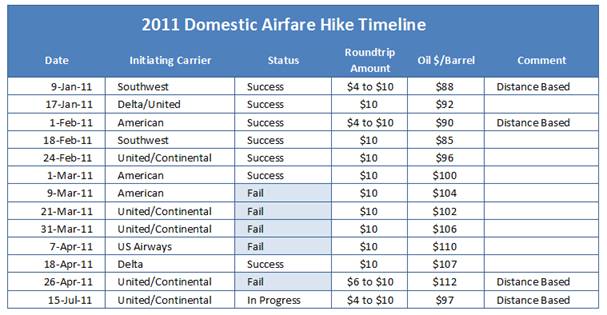
Airlines Starting Another Fare Hike Attempt as Summer Peak Arrives?


[Chart: Rick Seaney, Farecompare.com]

If it's Friday it might be time for another concerted fare-hike attempt by domestic airlines. Yup, the 13th this year, in which seven so far have been "wildly successful," says Rick Seaney of Farecompare.com, who watches this stuff like a hawk.

United/Continental launched the first domestic airfare hike attempt since late April this morning, he says. "United increased prices by $4 to $10 roundtrip (loosely based on trip distance)," he adds.

However, "fortunately for the domestic air traveling public the new airline economy ushered in by high oil prices in late 2007 requires domestic airlines to fill every middle seat with price sensitive folks – effectively limiting an unchecked rise in ticket prices," Seaney says. So the airlines appear to be biting into fare hikes in small increments instead.

From Seaney:

"I suspect United is probing their competition’s appetite for a lift in ticket prices as airlines have some recent booking demand trend information after launching a couple of fall sales the past few weeks.

"Domestic airlines still have to operate within a competitive equilibrium of never being $1 more or less than their competition (except when they have a convenience advantage) simply because carriers that are $1 more than their competition end up on page 15 of popular comparison shopping sites."

###

U.S. Wants to Require Airlines to Report Fee Revenue in Detail


Trying to get a handle on just how much airlines take in each year in so-called ancillary revenue -- that is, fees added to fares -- the U.S. Transportation Department today proposed a new rule that will require airlines to report more information on the amount and types of fees collected from passengers.

The proposal would revise current reporting requirements "to improve data collection on the amount airlines receive from different, specific types of fees," the department said.

Airlines now submit quarterly reports on revenue from baggage fees and reservation change fees to the DOT’s Bureau of Transportation Statistics. Airlines received $3.4 billion from baggage fees and $2.3 billion from reservation change fees in 2010.

The airlines strongly oppose any move by the government to require them to be more specific in accounting for their various fee revenues.

Here's the gist of the issue:

Last year, the usual suspects in the media were falling over themselves reporting that domestic airlines pocketed $7.8 billion in "ancillary fee" revenue in 2009, according to Transportation Department data. For a year, that was the media benchmark number, endlessly repeated, for defining "fee revenue."

But last month, in the new, long-delayed report on annual ancillary fee revenue for 2010, the Transportation Department switched its procedure and reported the figure for 2010 at $5.7 billion. The usual media suspects rushed to report that, without noting the $2.1 billion discrepancy between the 2009 total and the 2010 total -- at a time when it's well known that ancillary fee revenue has been going up, not down.

The Transportation Department noted that the 2010 figure was just for bags and change fees, underlying its frustration with trying to get the airlines to break down their other fee revenues coherently.

The usual media suspects failed to show any curiosity about the difference between the 2009 and 2010 figures, though. The difference is explained by the fact that the Transportation Department's Bureau of Transportation Statistics had been scrambling, unsuccessfully, to try to find a way to more accurately report the wide range of ancillary fee revenue, not just checked bag fees and itinerary-change penalty fees (which were $5.7 billion in 2010), but the wide array of other fees, like charges for priority seating, in-flight meals, standby status, inflight entertainment and the like.

Adding to the confusion was the fact that the annual reported ancillary-fee number included revenue the airlines make from selling frequent-flier miles to credit card companies for resale to customers. That revenue does not reasonably belong in any useful "ancillary fee" category.

In previous years through 2009, some but not all of those fees were included in the "ancillary fee revenue" total along with the much firmer numbers for checked bags and reservations change penalties -- while other fee data were scattered (to the extent that airlines reported them at all) in different categories such as miscellaneous revenue.

Some estimates by industry analysts put the total actual fee-revenue number for 2010 at over $10 billion, once all of the fees are included, and the number for mileage sales is stripped out (and put in a different category).

"Our goal is to improve the quality of data we collect from airlines and make airline pricing more transparent," Transportation Secretary Ray LaHood said today.

Today’s so-called Notice of Proposed Rulemaking is designed to require airlines to report 16 additional categories of fee revenue in addition to the baggage and reservation change fees.

The department said: "Identification of all ancillary fees and the amounts collected by each airline would improve information available to the public and help determine the impact of the increasing use of these fees on the Airport and Airways Trust Fund. Collection of data on fee revenue was recommended by the Government Accountability Office (GAO) in a July 2010 report."

All of which I have pointed out several times in the recent past, by the way.

###

Thursday, July 14, 2011

Legionnaires Disease Outbreak at Vegas's Aria Hotel


The huge Aria hotel in Las Vegas is telling guests who stayed there between June 21 and July 4 that a "high level of Legionela bacteria" was found "in several of our guest rooms."

In a letter to customers who stayed there during that time, the hotel says it knows of "a few reported instances of people who visited Aria [and] were diagnosed with, treated for, and recovered from Legionnaires disease."

Here's the letter, via VegasTripping.com.

Legionnaires Disease got its name from an outbreak of the disease at the old Bellevue Stratford Hotel in Philadelphia during a convention of American Legion members in July of 1976. That outbreak killed 34 and caused illnesses in hundreds more.

###

###

Wednesday, July 13, 2011

At Least 16 Dead in Brazil Plane Crash

[Photo: An L-410]

A Czech-built L-410 commuter plane crashed after takeoff from the northeastern Brazilian city of Recife, and at least 16 are dead. Here's the AP report.

The plane, flown by a Brazil airline, Noar Linhas Aereas has a capacity of 19 passengers and two crew.

This model of plane has been notable for fatal accidents worldwide in third-world countries over the years, including four crashes in Latin America. On September 10, 2001, a L-410 carrying 19 people, including University of Washington football fans and alumni association members, crashed into the jungle in Yucatán, Mexico, killing all on board. That disaster, of course, was largely overlooked in the media because of what occurred the very next day, which was 9/11.

One bizarre recent major L-410 crash (here) was in the very-dangerous-to-fly-in Congo, last Aug. 25. According to the single survivor, the L-410 crash occurred after a crocodile escaped from a duffel bag in the cabin and passengers stampeded to the front, throwing the plane off balance.

The most recent major crash was last February, when an L-410 operated by Central American Airways carrying 12 passengers and 2 crew members, crashed before landing at Toncontín International Airport. All passengers and crew were killed, according to the Wikipedia entry on the aircraft.

###

TSA: 'Say What?' Woman Arrested for 'Verbal Abuse' Over Patdown of Her Daughter

I don't know much about the details of the latest incident involving a parent's objection to the TSA patting down a female child, but I am seeing what appears to be a disturbing trend. That is, the notion that angry verbal reaction can be deemed a crime.

Look at this report in the Tennessean newspaper of Nashville about the arrest of a 41-year-old woman, Andrea Abbott, in such a case. In particular, note the comments from one Sabrina Birge, sloppily described (will local reporters ever learn specificity?) as "an airport security officer." The italics are mine. (And again, the incident involves a Southwest Airlines gate area)

"(She) told me in a very stern voice with quite a bit of attitude that they were not going through that X-ray,” Sabrina Birge, an airport security officer, told police.

"`No, it’s not an X-ray,' she told Abbott. `It is 10,000 times safer than your cell phone and uses the same type of radio waves as a sonogram.'

“`I still don’t want someone to see our bodies naked,'" Abbott said, according to the police report.

"At one point, Abbott tried unsuccessfully to take a video with her cellphone."


Let's leave aside the risible idea that anyone should have faith in the assurances of a TSA screener about the scientific properties of a whole-body scanner, whether one that uses X-ray or radio waves. The offenses for which the woman was arrested appear to be these: "Stern voice with quite a bit of attitude" and trying to take a video with her cellphone.

Again, we have a dispute that appears to center on an overreach of authority by security officers at an airport, who evidently are allowed to operate in the misguided notion that they are the speech police and that they can prevent someone from taking a video or a photograph as they go about their jobs.

Again, we have a local newspaper feebly regurgitating only what it has been informed by the authorities. The woman was "belligerent and verbally abusive," we are informed.

And how, exactly, is that defined? And where, exactly, is "verbally abusive" listed as a crime?

Obviously, "disorderly conduct" is the usual catch-all for a bad arrest in a dispute. Someone needs to ask the TSA, the reaction-inclined Southwest Airlines and the Nashville airport to explain themselves.

###

Saturday, July 09, 2011

The Clueless Media, the Clueless Sheryl Crow, and Wild Horses

[Photo: Wild horse rodeo event in Wyoming]

As a horseman, I always brace myself when I see another media story on horses in general, and wild horses in particular.

This particular story in the Washington Post, about the alleged "wild horses" of Assateague Island in Maryland, is one case in point. It's not inaccurate, or anything, and it's certainly interesting. But it's clueless about what a wild horse actually is.

For years, the kinds of cosy-moments newspaper travel editors who think the Cotswolds are the height of splendor published regular breathless stories on these famous "wild horses" of Assateague Island.

Now it seems the world famous Assateague "wild horses" are not only not wild (I coulda told you that a very long time ago), but they also behave like bears at Yellowstone, or like sideshow monkeys. That's because all the tourists keep flocking in and feeding them.

These horses not only are not wild -- they are not even normal like domesticated horses.

Time to put the kibosh on this particular tourist attraction, I say.

Meanwhile, out West, the media love romanticized stories about wild horses and the alleged need to accommodate them in their purportedly totally wild state -- heedless of the reality that for a horse, a life in the pure wild (assuming there is such a thing anymore) is usually short and brutish.

The performer Sheryl (I Never Met a Gig I Wouldn't Take the Dough For) Crow is currently one of the celebrity hucksters crusading against sensible federal policies regarding wild horses in the not-any-longer-very-wild West. These are generally people who do not know anything about horses, about how horses behave naturally, and about what horses require to thrive in safety and security (like vet care and adequate nutrition, for example.).

Still, Ms. Crow will be performing at the controversial rodeo at the Cheyenne Frontier Days festival in Wyoming later this month. Have a look at how that goes down, horsewise.

That rodeo also includes the notorious "wild horse race" in which horses are often injured, all part of the horseplay fun.

Responsible rodeos--and rodeoers--do not condone such spectacles.

But Sheryl Crow, the wild-horse crusader, evidently has no problem with it, and after horse people began complaining, her "people" said she would make a "generous donation" to the wild-horse cause. Long as the check clears.

###

At Least 74 Dead in Crash by Banned Congolese Airline

A 46-year-old Boeing 727 crashed while attempting to land at Kisangani airport in Congo, killing at least 74 of the 118 on board. Here's a news report on the crash.

The plane was flown on a domestic flight by Hewa Bora Airways, which is on a banned-airlines list maintained by the European Union to identify airlines that have severe problems. Here is that list.

The plane that crashed was listed variously by international safety sources as Boeing 727-030 or 727-022(WL). Registration: 9Q-COP, according to Planespotters.net

No one who has any choice would fly an airline like Hewa Bora, but of course lots of people have no choice (and no access to reliable safety warnings) in a corrupt, wretched country like Congo where even roads are a novelty outside the cities.

One area of inquiry would be useful, as investigators start work. That is, what's the history of this particular aircraft? From whom did Hewa Bora Airways acquire the 727?

###

Goodbye to Space Shuttle Technology and All That


...And good riddance to this empty-science boondoggle that's based, essentially, on TNT strapped to a tin can with people inside -- while media weep lachrymose tears. Total cost of this program: $200 billion. Yield: Tang, some dramatic photos (including tragic ones), plus decades of mind-numbing purple prose from the Victorian Gentlemen of the Space Program Press Corps.

Time now to renew and rejuvenate our serious, scientifically thrilling efforts in exploring the actual universe -- you know, real outer space, unmanned, and not focus on a piece of junk barely in orbit, a mere 200 miles up?

###

Thursday, July 07, 2011

Big Spike in Long Tarmac Delays in May


They'll be spinning this like a weaver on crystal meth, but there was a very large spike in tarmac delays of over three hours in May, according to Transportation Department data released today.

The sharp May increase -- to 16 -- argues for asking the question: Have airlines begun to believe that the DOT rules, which set fines of up to $27,500 per passenger for tarmac delays exceeding three hours without very good reason, are toothless -- driven by agency publicity rather than by a serious commitment to enforcement? The current figures are by far the highest since the rules went into effect in April of 2010. At that point, three-hour-plus delays plunged sharply, but the number crept up to four in April (the DOT blamed bad weather in Atlanta for three of those), and then quadrupled in May. The trend is not encouraging.

The DOT has yet to fine a single airline since the rules went into effect, incidentally.

###

TSA: Is That a Bomb in Your Hair or Are You Just From South Jersey?


The TSA hits just keep on coming.

Here's a story about a woman who was hauled aside to have her hair pawed through because it was deemed to be poofed. "We're going to have to examine your hair," a TSA screener told her.

These kinds of incidents never fail to remind me of the time I saw a woman in a full head-to-foot burka, face totally covered, being given a breezy wave through security in Detroit, with no attempt to match her face to her ID, because the TSA policy is that religious "sensitivity" trumps security. Allahu akbar, as they say when they pull the pin.

Or as Ron White says, "Ya can't fix stupid."

Meanwhile, in Florida, a TSA agent was fired for stealing passengers electronics and putting them down his pants. Ya can't make this stuff up

###

Wednesday, July 06, 2011

TSA and Personal Hiding Places for Explosives

Uh, oh.
...is all I'm sayin'

###

Feeling Cramped On That Flight?

Delta Air Lines today released its June traffic results, the first for the month reported by a major airline. They indicate that airlines are continuing to constrict, while planes were continuing to fly near record load-factors as the summer travel season commenced.

Delta flew 1.5 percent fewer seats domestically in June, compared with June 2010. Its domestic load factor, the percentage of seats filled by paying customers, was 86.5 percent -- a percentage that would have been considered astonishing in the industry only a few years ago, but is now routine. (Last June, the Delta domestic load factor was 87.6 percent. Load factors over 80 percent, though, indicate that most planes are flying totally full most of the time, as we all know).

We'll soon see what the other airlines report for June.

###

Thursday, June 30, 2011

Business Jet Politics: Time to Round Up the Usual Suspects?

President Obama mentioned the "corporate jet tax break" several times in his comments about tax loopholes for the rich this week.

Beating up on private jets is always good for scoring political points. People who don't fly in them hate corporate jets. (Personally, I am quoted in the current issue of Business Jet Traveler magazine as saying that the very first thing I would do if I acquired an extremely large sum of money is "order a G-650." But I would also not squawk about paying a fair tax on it, either, as I headed to the Cannes Film Festival with my entourage. Hell, I'd be rich.)

Anyway, as usual, the private jet industry responds to an attack by huffing and puffing -- and missing the opportunity to deliberately argue the sensible case for business aviation.

Incidentally, how significant is the "corporate jet tax break" in the overall context of potential revenue for the federal government?

Negligible, is the answer.

But instead of making a reasoned case based on this, the industry and its assembled amen choruses are wasting their breath insulting the president and sending what they risibly describe as "strongly worded" letters to the White House.

As the old joke-telegram went: "F--- you. Strong letter follows."

Business aviation needs to smarten its head as we brace for hitting the economic wall in tax policy. And that collision will be followed quickly by the presidential election season.

Trust me, no one in politics will be standing up to defend some hump of a CEO taking the corporate jet to Nantucket with the wife, kids, nanny, and poodle all aboard. And thanks to some hump CEOs, that is what the public sees when they think of corporate jets.

Why is it so easy to pick on the corporate jet? Well, I'd merely refer you to recent stories in the Wall Street Journal, which has been hammering away at the business aviation world. I've always thought of the Journal as being like the wise old veteran sheriff trying to maintain law and order in an invincibly crooked town. Once in a while, the sheriff and his deputies have to ride around town with six-shooters drawn, raiding the whore houses and rousting some of the girls. Commotion ensues, but in a few days the girls are all out of jail and all returns to normal for a long spell. It's all a matter of optics, you see.

(I was an editor and reporter at the Journal for about seven years, incidentally, and I say the above with a degree of insight).

Anyway, the Journal has been doing bang-up work on corporate jets, with a serious focus on abuses. The best argument for business aviation is that a private jet is a very sensible business tool whose utility goes right to the bottom line as a plus, given that business needs to get done and our commercial air-travel system makes it very difficult to get quickly from Point A to Point B, without stops at Points C-D and sometimes E along the way.

But as the Journal has been pointing out, at many companies, the CEO has first dibs on the company plane or planes, and treats them like glorified limousines, including using them for personal trips. Hilariously, the Journal has reported on some CEOs who claim they need to travel on a heavy-metal luxury Gulfstream because of "security." That is, some pant-load of a CEO at some company claims, ridiculously, that he or she is such a great world personage that there is a need to avoid the public -- who overwhelmingly have never ever heard of this person or in many cases even the company.

In ignoring these clowns, the business-aviation industry whistles past the graveyard when these abuses are discussed in public, as they increasingly are. Every time the public outrage about business jets rises, as it has begun to rise once again, the opportunity is lost to make the viable case for business aviation, if the stance is to ignore the obvious abuses and send a message of support to the CEO with the poodle.

David Kashdan, a Journal reader, wrote a letter to the editor recently that made some very good points.

"Your article nicely details management abuse of corporate jets, at significant cost to shareholders," he wrote. "This abuse also causes corporate jets to be less available for use by middle managers who do much of the company's business. Twenty years ago it was common for a broad spectrum of managers to use corporate jets, but now the "privilege" is reserved largely for the top echelon, who view the plane as a personal perk rather than a corporate asset. ..."

The public back in row 18 on that 737 senses this. Public disdain for the fat-cat abusing the company jet will grow.

The crowds in Paris sensed that there was nothing in the Bastille except some lunatics and some lightly guarded ammunition stores.

They stormed the hell out of it anyway. The anniversary, by the way, is coming up.

###

###

Sunday, June 26, 2011

TSA Pats Down 95-Year-Old Woman, Orders Her to Remove Adult Diaper

A 95-year-old Florida woman in a wheelchair was strip-searched by TSA screeners and made to remove her adult diaper because it was "soiled," her daughter says in a complaint filed with the Homeland Security department.

The incident occurred last week at the Northwest Florida Regional Airport in Panama City. Here's the report in the Panama City News-Herald newspaper. Here is a later and more detailed report from CNN.

The TSA comment on diaper-desperadoes: "TSA cannot exempt any group from screening because we know from intelligence that there are terrorists out there that would then exploit that vulnerability."

###

Tuesday, June 14, 2011

Sharkey's Law: Every Truly Bad Idea Eventually Has Its Day


Yes, you can buy this toy and let your kid grope along as a junior T.S.A. agent. What's that you're hiding there?

Here's the link.

Sharkey's Immutable Law: Every truly bad idea eventually has its day.

###

Monday, June 13, 2011

WTF? Flight Attendant Turns Around Flight After Hearing a Bad Word

[Photo: She can send you to Hell, but an Atlantic Southeast flight attendant can send you to Detroit.]


Most flight attendants are hard-working and courteous -- and you can be sure that any column that begins that way is a story about another report of another dumb hump of a flight attendant who thinks he (and it is usually a 'he,' for some reason) has the power of a nun in charge of the school detention hall.

Yup, here it is.

A 37-year-old passenger was tossed off his Delta flight in Detroit on Sunday after a flight attendant heard him use the word "fuck" -- in a casual comment to a passenger beside him.

Robert Sayegh, of Brooklyn, tells the Detroit Free Press newspaper that he was returning from a trip to Kansas City when he said a flight attendant overheard him use the word in complaining to a fellow passenger about a 45-minute delay.

"I was just kind of talking to the guy sitting next to me. I said 'What is taking so long?' I said “What the 'F' is going on?'" Sayegh told the newspaper.

The (male) flight attendant with the virgin ears pulled the panic button and the flight, operated for Delta by Atlantic Southeast Airlines, stopped taxiing on the runway and returned to the gate, where Detroit Metro Airport police boarded the plane to escort the brazen malefactor off.

The Detroit newspaper reporter, evidently unaware that the word that gave the flight attendant the vapors is used all the time in Detroit as well, helpfully explains that using the f-word is "part of the Brooklyn vernacular."

The passenger from Brooklyn says he's suing. I mean, he's f---king suing the f---king stupid f--ks.

###

Saturday, June 11, 2011

Fireworks in Arizona


The headline isn't a joke. Six months ago, it became legal to sell fireworks in Arizona, and businesses, churches and nonprofit organizations in various cities and towns are busily peddling them now.

In a state where desert areas haven't had more than a half-inch of rain since Thanksgiving, I can head to a supermarket or a church and load up on fireworks. Here's the fireworks industry's Web site for Arizona.

I can't set them off in Tucson because Tucson, at least, has some brains. But hey, no prob -- I can head out of town and set them off legally -- in a desert region where fire-hazard conditions are so extreme that the Saguaro National Park on the east side of town, as well as all areas of the vast Coronado National Forest, not to mention all Pima County parks and trails -- have been closed indefinitely to almost all public use because the threat of wildfire is so high right now.

You can't take a hike or ride a bike or horse on a trail, but dang, if you aren't on government land you can set off fireworks -- in a state where large areas are currently aflame with massive wildfires, like this one in the Apache-Sitgreaves National Forest. More than 3,400 firefighters are currently battling that one, which started on May 29 and has burned over 400,000 acres, and is the second-worst fire in the state since records were kept.

Or this one, which started May 8 in the Chiricahua Mountains southeast of Tucson, where 134,000 acres have been burned and the fire is still not even half-contained. Or this one, which firefighters have finally got nearly fully contained in desert terrain and dry grasslands south of Tucson near the towns of Arivaca and Tubac.

The local media are, naturally, solicitous of the churches and nonprofits peddling fireworks. After all, the thinking seems to go, despite the obvious threat to the public welfare posed by fireworks .... well, it's for a good cause. For some churches, it's a big bang for Jesus.

The local media are, naturally, utterly oblivious to another aspect of the fire danger crisis, which is that with the parks and wilderness areas closed to the public, there are whole lot more hikers, bikers and horses now forced onto more sections of public roads, and motorists need to be aware of the additional safety issues involved.

Meanwhile, some state officials have been criticizing the constantly reviled federal government for what they regard as an inadequate emergency response to the wildfires.

Seems that the nativists of Arizona understand that the federal government does have a job to do -- when their house is on fire.

If Amtrak were to run a long-distance train to Phoenix it would have to be called the Arizona Disconnect.

###

Friday, June 10, 2011

You Should've Seen Coney Island in Those Days


[Photos: Coney Island in the 1940s]

Today, there's a front-page photo in the Times showing Coney Island beach during yesterday's scorching temperatures on the East Coast. The picture is cropped in a way that makes the beach look totally jammed. Granted, the beach was very crowded yesterday, but when you look on the edges of the crop you can see that it's only a mid-section that's full, and there's a lot of space between some of those blankets.

But there was a time, before air conditioning and the Interstate Highway System and the suburbs, when a blazing hot day in New York brought a million people to Coney Island, nearly all by subway. Ah, you should've seen it in those days, to allude to Burt Lancaster's haunting line about the Atlantic Ocean in Louis Malle's movie "Atlantic City." (The actual line is: "The Atlantic Ocean was something then. Yes, you should've seen the Atlantic Ocean in those days.")

In some of those vintage Coney Island photos from the 40s and 50s, the beach is so full it seems that another person couldn't fit in, even greased with a full bottle of Coppertone. And those old photos bring to mind another movie allusion, Woody Allen's crack that German submarines tried to invade Coney Island during WW2 but were destroyed by the pollution.

###

Thursday, June 09, 2011

Alert for Tourism in E. Central and Southern Arizona

As a monster fire continues to burn out of control in the Apache-Sitgreaves National Forest 250 miles east of Phoenix, travelers in Arizona need to stay alert about highway closings.

Meanwhile, the media continue to focus almost exclusively on structures, while overlooking the profound environmental disaster on vast areas of Arizona wilderness and recreational lands.

Here's the update on that fire, called the Wallow fire, which now involves more than 3,000 firefighters and has burned nearly 400,000 acres.

Today, nearly 20 miles of U.S. 60 was closed from Springerville to the New Mexico state line. The closing stretches from milepost 384 to 401, the state highway department says, adding:

State Route 260 is closed in both directions east of the Hawley Lake turnoff (State Route 473 junction) and Eagar. SR 260 is closed between mileposts 372-398 near Eagar.

State Route 373, a 4.5 mile-long highway that connects the town of Greer in eastern Arizona with SR 260 west of Eagar, is closed.

U.S. 191 is closed between Alpine and north of Clifton (mileposts 176-253).

State routes 261 and 273, the main access roads to Big Lake and Crescent Lake in the White Mountains, are closed. SR 261 is closed starting approximately seven miles south of SR 260 to Crescent.

Lake (mileposts 395-413) and SR 273 is closed between the SR 260 junction and to the SR 261 junction (mileposts 378-394).

U.S. 180 is closed between the SR 260 junction near Eagar and the New Mexico state line (mileposts 403-433).

Besides the Wallow fire affecting the above closings, there is another large fire, the Horseshoe fire, burning in the Chiricahua Mountains east of the old cowboy town of Tombstone (a tourist spot) in the southern part of Arizona, where 116,000 acres have burned. Firefighters today are worried that the Horseshoe fire, which was thought to be on its way to containment, may now be spreading as dry grass and other brush pose extreme dangers.

Also in southern Arizona is another large fire, the Murphy fire, burning on grasslands and desert terrain between Arivaca and Tubac (a big tourist destination) just above the Mexican border, south of Tucson.

Roads and tourism in those areas are also affected.

In addition, as I noted yesterday, forest, mountain and desert recreational areas throughout the Tucson region and south are adversely affected by the extreme fire dangers in the region, where temperatures are high, relative humidity is very low, winds are breezy -- and where it hasn't really rained since last Thanksgiving.

The Tucson region is famed for hiking, biking and horseback riding -- and fire danger has put the kibosh on all of those. All of the trails and washes in Saguaro National Park on the east side of Tucson are now closed indefinitely, till the extreme fire danger passes, possibly not till monsoon season in July, when the Sonoran Desert gets most of its annual rainfall. All of Pima County's trails and washes are closed, as are all regions of Coronado National Forest.

###

Wednesday, June 08, 2011

As Arizona Wildfires Burn, Saguaro National Park Shuts Its Trails; Pima County Also Closes Trails in Tucson and Southern Arizona


[UPDATED 4 pm ARIZONA TIME]
One of the ecological gems and major tourist attractions of southern Arizona, the Saguaro National Park on the east side of Tucson, is almost entirely closing to the public at noon tomorrow because of the extremely high danger of fire.

The park closing -- which includes all trails and washes -- is described as indefinite, until extreme fire hazard conditions lift. For the time being, the park's eight-mile-long scenic loop drive, the visitor center and a small nearby picnic area will remain open, however.

This afternoon, Pima County also closed all of its trails in the Tucson area, also indefinitely. Here's the county notice, which does not state whether the closings will begin at noon, like the Park Service closings, or early in the morning.

Basically, though, hiking and horse trails and related public recreation sites in Tucson and vicinity are now closed till the start of the monsoon season, which won't occur till July. Tucson is one of the leading centers in the country for mountain and trail biking, and that also will be sharply curtailed.

[Meanwhile, as wildfires rage elsewhere in the state, the media seem to be focusing entirely on a huge fire in mostly wilderness areas in the Apache-Sitgreaves National Forest 250 miles northeast of Tucson (and about the same distance east of Phoenix.)

[And that focus seems to be mostly on structures -- that is, the relatively few homes and cabins in the affected area around the town of Alpine and the people who live there, where evacuations are continuing.

[Myself, I think we've probably had enough stories along these lines now. We know folks become unhappy when a fire approaches their homes, and we've seen those wildfire photos a million times from many different places. Frankly, they all look alike, as dramatic as those flames and smoke plumes are.

[Wouldn't it be better to focus a bit more on the serious environmental disaster at hand, as hundreds of thousands of acres of pristine wilderness and back-country recreational areas are being rendered unusable -- for years if not a decade or more? Or maybe a little attention to the astonishing firefighting response, with thousands of firefighters toiling day and night in extreme heat and danger, and the rapidly mounting costs of all that? Or how about the fundamental reasons for such fires. Especially vis a vis the fires and fire hazards in the Sonoran Desert in the southern part of Arizona, it's probably time that reporters learned what buffel grass is and why it's an invasive fire-menace to the desert ecosystems. That's where this story goes from here, folks.]


Anyway, the biggest fire currently burning is the so-called Wallow fire in a wilderness area about 250 miles east of Phoenix, in Apache County, near the New Mexico border. That one is the second-worst in state history, and so far has burned 389,000 acres. It remains zero-percent contained, as of mid-afternoon today Arizona time.

There is another big one, called the Murphy fire, in rugged desert terrain between two towns, Arivaca and Tubac, near the Mexican border south of Tucson. Lots of people do live in that area, but so far evacuations haven't been called for. (And the media are all focused on the massive fire in the wilderness 250 miles east of Phoenix, meanwhile). Another big fire, called the Horseshoe fire, is burning farther east, in the Chiricahua Mountains that rise out of dry desert grasslands east of the old cowboy town of Tombstone. The latter two fires are in sections of the Coronado National Forest.

Meanwhile, back in Tucson, the Saguaro National Park closings come as the vast areas of Coronado National Forest, also in southern Arizona, also are closed because of the various fires and the extreme fire hazard conditions in areas that are not burning. In the various Coronado park districts, only the highway to the village of Summerhaven at the summit of 9,300-foot Mt. Lemmon overlooking Tucson remains open, and only during the day. That road has to be kept open because several hundred people live in the village.

Here's the National Park Service bulletin on the closing.

The local paper in Tucson, which I call the Daily Stupid (current main headline on Web site, and I am not making this up: "Is Tucson the Best Town Ever?") has run lots of dramatic photos of people gazing with alarm at smoke in the affected areas, but has been short on maps and useful reporting on the fires and their local ramifications. As the local paper had it, only the high mountain trails of Saguaro National Park East will be closed. (There is another, lesser section of the national park on the west side of Tucson. It's not covered by the closings.)

But in fact, all of the trails are being shut down, including the numerous horse and hiking trails and washes at lower levels. Besides tourists (and the Germans, for some reason, love the heat of southern Arizona this time of the year) local residents (like me) use these trails and washes, as do the Tanque Verde Guest Ranch and some other smaller neighborhood trail-riding operations.

The rangers tell us here (and would tell any local reporter who found the initiative to simply inquire) that because so much of the regional firefighting force is deployed in the big fires elsewhere, and because of staff cutbacks in the park service, keeping the horse and hiking trails open could be dangerous.

The temperatures in Tucson are in the high 90s, after about a week of temperatures over 100. Relative humidity remains around five percent. It's windy today, and has been breezy or windy for a week. It hasn't really rained in this part of Arizona since last Thanksgiving, and the monsoon season, when southern Arizona gets most of its annual rainfall, is a month away at best. These are extreme fire-hazard conditions.

So prudence prevails. A carelessly tossed cigarette or any kind of flame can ignite a major conflagration in these conditions.

It's probably futile to point out, but nevertheless of interest, that experienced people on horseback can be reliable observers who see more of the landscape from a horse -- which is why cities like New York have mounted cops. Also, the kind of horsepeople and hikers who are on these trails at this time of the year tend to be experienced in parksmanship, and hence could be used by the park service as an extra set of eyes.

But emergency conditions are at hand, and nuances can come later.

###

Soldiers Say Delta Overcharged Them on Checked-Bag Fees; Delta, Aghast, Rushes to Revise Bag Policy for Military

[Please see my personal note on Delta at the end of this post]

The AP reported this morning that soldiers returning from Afghanistan posted a video on YouTube about having to pay Delta Air Lines $2,800 out of pocket to check extra bags that their Army orders said they could check without charge.

Airline stupidity, please meet your PR emergency squad rushing in to do damage control. As news of the video spread, Delta rushed out a press release this afternoon saying it has increased its free checked baggage allotment for U.S. military traveling on orders in coach to four checked bags.

From Delta:

"Delta's revised baggage policy also allows U.S. military personnel traveling on orders in first and business class to check up to five bags at no charge. This change also adds dependents traveling with active military on orders. Each bag may weigh up to 70 lbs. (32 kg) and measure up to 80 linear inches (203 cm), which offers added flexibility over the standard 50 lbs. and 62 linear inches (157 cm) allotment. Because of weight, balance and space constraints, Delta Connection carriers accept up to four bags at no charge.

"For personal travel, active military presenting military identification may now check up to two bags weighing 50 pounds (23 kg) or less and measuring 62 inches (158 linear cm) or less in combined length, width and height without charge.

"Previously, Delta's policy allotted three free checked bags in economy class and four in first and business class for military members traveling on orders.
"

In the YouTube video, according to the AP, "the soldiers say their Army orders authorized them to bring up to four bags with them as they returned from Afghanistan to Fort Polk in Louisiana. They say when their 34-member unit checked in at Baltimore-Washington International Airport for Delta flight 1625 on Tuesday, the airline charged them $200 each if they had a fourth bag."

Personal note: As a veteran who spent four years in the service, including a year in Vietnam, I still remember how well Delta treated military personnel traveling on its planes in the second half of the 1960s. Everyone I knew in the service regarded Delta as a class act as regards the military, and many of us still remember it.

###

Monday, June 06, 2011

Row 44 Signs Lufthansa Technik for Satellite-Based Inflight Entertainment Platform Installations

Keep your eye on Row 44 and the inflight WiFi entertainment platform it is starting to roll out.

Row 44 is, of course, the competitor to inflight WiFi leader Aircell. Aircell has installed its land-antenna-based Gogo WiFi system on about 1,100 domestic planes, with nine airline customers. Row 44 is installing its satellite-based WiFi system on Southwest's fleet of about 540 Boeing 737s, and also has Norwegian Air Shuttle as a customer.

But Row 44's strategy is to boost value by introducing a wide range of inflight entertainment and other services in a platform specifically designed for each individual airline. I recently spent a day in Las Vegas and on a test flight with Row 44's Howard Lefkowitz, the savvy innovator who made Vegas.com into the leading purveyor of hotel, entertainment and other reservations services in Las Vegas.

More on that adventure tomorrow.

Meanwhile, here's the press release on the new link between Row 44 and Lufthansa Technik, the big German provider of aircraft maintenance and cabin design and modification services:

WESTLAKE VILLAGE, Calif., June 6, 2011 -- Row 44 Inc., provider of the world's leading in-flight broadband entertainment platform, announced today it has formed a partnership with Lufthansa Technik, global provider of manufacturer-independent maintenance, repair, overhaul and modification services to civil aviation.

As a result of this partnership, commercial airlines that select Row 44's In-flight Broadband Entertainment Platform will be able to take advantage of Lufthansa Technik's extensive and globally available installation, certification and integration services. Row 44 will certify and work closely with Lufthansa Technik to reduce installation and maintenance time and costs, reduce overall project risks, and optimize the considerable passenger – facing and airline operational advantages of the Row 44 solution for each airline customer.

Lufthansa Technik will also leverage its global reputation as an innovative and trustworthy commercial-aviation engineering firm to support successful integration of Row 44's in-flight broadband entertainment platform to airlines around the world.

"Row 44 is extending our services globally," said Vice President of Sales Frederick St.Amour. "Working with such a highly respected and successful engineering services firm as Lufthansa Technik gives us tremendous confidence that Row 44's products and airline partnerships will be well supported and highly successful worldwide. We are honoured to be working with Lufthansa Technik, and look forward to developing our relationships with them."

"This partnership reinforces Row 44's commitment to excellence for our airline partners around the world," said Howard Lefkowitz, Row 44's Chief Commercial Officer. "Lufthansa Technik's reputation for excellence is known throughout the industry, and Row 44 is proud to be able to deliver airlines such a high level of engineering service as part of our offering."

Dr. Stephan Schulte, Product Manager for Aircraft Modification and Engineering Services in IFE added: "This partnership means an important milestone in our strategy for the expansion of our installation-design engineering and certification services in the IFE and IFC market. We are happy to be given the chance to bring in our wide ranging experience and knowledge which we could successfully gain from various related projects in the past. ..."

About Row 44 Inc.

Row 44, Inc. provides the world's leading in-flight broadband entertainment platform for commercial airlines. The company's flying Wi-Fi hotspot — which delivers the world's fastest aviation broadband speeds to passengers — provides airlines with an unmatched selection of revenue-generating and experience-enhancing entertainment, shopping and destination services. The company is partnering with airlines around the world, including world-renowned Southwest Airlines and 2009 Market Leadership Award recipient Norwegian Air Shuttle, to deliver a series of truly remarkable products to improve the commercial flying experience. For more information, visit www.row44.com.

About Lufthansa Technik AG

Lufthansa Technik is one of the leading manufacturer-independent providers of maintenance, repair, overhaul and modification services in the civil aviation industry. With tailored maintenance programs and state-of-the-art repair methods, Lufthansa Technik ensures the unbroken reliability and availability of its customers' fleets. Lufthansa Technik is an internationally licensed maintenance, production and development organization. Lufthansa Technik is considered very well experienced in the integration design of IFE and IFC systems.

###

Friday, June 03, 2011

The Looming Showdown for the TSA (Oh, and TSA: Have You Met ACORN?)


I fully understand that the TSA screens about a million and a half passengers a day, and does so with professionalism and courtesy. For the most part.

On the other hand, the TSA is carrying a lot of baggage, and it's my guess that the agency is headed for a showdown in Washington and in the states, as complaints about these infernal body patdowns pile up along with all the other public misgivings about the agency, which range from excessive costs (about $8 billion a year) and the routine arbitrary and capricious invocations of "laws" that may or may not even exist.

The agency especially needs to get its act together on the latter. For example, what is the law about a citizen making making video of TSA agents who, arguably, might be seen to be overstepping their boundaries?

Who says you can't film them? Where does it say so? What is the reason, if so? If you're so proud of your professionalism, as you may well be, what's your problem with having the public see you do your jobs?

In this video, which is getting around this morning on the Internet, a woman at the Phoenix airport is obviously upset at a TSA checkpoint where she has just been patted down.

O.K. -- watch the video. For most reasonable people, their first reaction is likely to be: Whoa, this lady is hysterical. She is overreacting. What the hell is wrong with her behaving like this?

But here's your real problem, TSA at Phoenix. Why didn't you just calm the lady down, deal with the problem -- and move on?

But nooooo. Instead, the TSA agents on the scene turn their attention to a man who seems to be the woman's adult son, who is using his cellphone or a camera to record the incident. For whatever reason. And I would not rule out the possibility that some people are deliberately creating, or at least exploiting, checkpoint incidents to aid and abet the growing public sentiment demanding that the TSA be replaced by private security firms hired by airports (TSA, have you met ACORN? They, too, starred on a guerrilla form of "Candid Camera").

The TSA agents fix on the man taking pictures and, true to form, begin acting like small-town cops. And speaking of small-town cops, along comes some hump who works for Southwest Airlines. Suddenly, he's Officer Krupke, but without the badge and the legal authority (and the chorus singing to him in "West Side Story")

As the distraught woman shrieks ridiculously, while standing as ordered at the patdown area, the following, instead, becomes the narrative we focus on:

Man with camera insists that TSA agents, and then the bossy Southwest Airlines guy, tell him what authority they have to order him not to record the scene. Here's some excerpted dialogue:

"Put the camera down!"

"It's against regulations!"

"Escort him out for noncompliance!"

"I don't have to show you the law. We're here to carry out the law!"

Man with camera: "It's a public area."

"You do not have my permission to film me!"

Man with camera: "Then walk away."

This goes on, making security look more and more silly, until what appears to be an actual police officer enters the picture. The police officer, as cops are trained to do, assesses the situation, evidently determines that there is no danger, and then tries to calm things down -- without threats. The cop, obviously, knows or at least supposes that there is no "law" against using a camera.

The cop behaves professionally. The TSA people who take it upon themselves to demand that the man put the camera down behave like security guards at the post-party of a Lady Gaga concert. The Southwest guy behaves even worse, given that he's just some airline hump.

This does not help, TSA. And Southwest: You are developing a reputation -- once those smiley faces disappear, it can become Guatemala on your turf, really fast.

The TSA needs to get its house in order here. What, specifically, is the law, or the rule you seek to enforce, about taking pictures? Where, specifically, do you assert that rule applies?

TSA rules are often haphazard. For example, you need to restrict carry-on liquids and gels to 3.4 ounce containers that fit into a one-quart zip bag. O.K., I get it, I get it. But then, there are exemptions, like for those with medical reasons and even "cosmetic" reasons -- including gel-filled bras and gel-filled cushions for your butt.

I'm not suggesting a crackdown on those with medical and/or cosmetic needs, but what's the rationale here -- aside from the need to assuage medical lobbying and various organized political interests? What makes sense here?

Speaking of political interests, as we all know, various state legislatures are proposing a crackdown against the TSA's hated patdowns, and in Texas a bill was introduced in the state house of representatives that would apply criminal law to TSA agents in cases where patdowns are deemed to constitute sexual groping.

The TSA scoffs at this, citing the Supremacy Clause of the U.S. Constitution, which prevents states from contravening federal law. And also, let us never forget the sainted columnist Molly Ivins' observation that "every time the Texas Legislature is in session, some village is missing its idiot."

Nevertheless, there's a storm brewing on the TSA (whose boss, and his boss at Homeland Security, usually travel by private jets, which allows them to avoid the TSA, like all private jet passengers). I hope the agency gets a handle on it with something other than blandishments from "Blogger Bob" on its Web site.

This morning, the House Transportation Committee Chairman John L. Mica will release an investigative report that, the committee says (with a disturbing neglect of basic grammar) "discloses the Transportation Security Administration (TSA) ignores skyrocketing passenger screening costs in all-federal screening model, and dismisses benefits of the model utilizing private contact screeners."

Grammar aside, read that as a further movement to support privatization of airport security.

The committee's press release adds, "This report will refute the Transportation Security Administration’s (TSA’s) prior claims that screening under the private-federal model is more costly than the all-federal model.

"In creating the Transportation Security Administration (TSA) after September 11, I2001, Congress provided in law the option for airports to 'opt out' and use private security screeners under TSA standards, supervision and oversight as an alternative to all-federal screening. Earlier this year, TSA pulled the plug on allowing more airports to opt out, citing cost concerns."

Mica will again call for the TSA to be required to allow airports to opt out and hire ... rent-a-cops. You know, like the ones who were on duty in Boston on September 11, 2001.

###

Thursday, June 02, 2011

Big Jump in International Air Travel in April

Traffic data for April showed a rebound in international markets with, 16.5 percent growth over April 2010, the International Air Transport Association says today.

This jump is exaggerated by the fact that in April 2010 during which European airspace was closed due to the volcanic ash crisis, international travel markets in April still were 7 percent higher than the pre-recession peak of early 2008.

Meanwhile, capacity also grew in April, by 16.8 percent, IATA says. Passenger load factors remained roughly equal.

"Eliminating all distortions, we are growing at 3-4 percent. International traffic is now 7 percent above the early 2008 pre-recession levels; load factors are hovering around 77 percent and business confidence is high. Unfortunately two things are spoiling the party: Demand shocks and high jet fuel prices,” said Giovanni Bisignani, the CEO of the group. By "demand shocks," he evidently meant volatile demand impulses created by fare hikes and surcharges, and other factors.

U.S. carriers are seeing much stronger demand in international markets (up 11.9 percent) than in domestic (up 1.2 percent).

###