
Finally, now that they're a little bored watching the thieves on Wall Street running around with their pants on fire, the U.S. media seem to be paying better attention to the rioting in the London area and a few other English cities -- as a police story, which it basically is, rather than as some ponderous political-sociological curiosity.
The other day, I mentioned here the journalistic basics, the so-called five Ws, that had been mostly missing in the coverage: The who, what, when, where and why. What we were getting way too much of: Cliched photos of flames. Photo editors love flames, and never seem to realize that one blazing fire looks pretty much like another, except for the background, whether it's in Wyoming or Tottenham.
Also, sadly missing from the coverage were useful locator maps showing us specifically where the trouble spots actually are -- even though (and maybe because, given the anti-historical proclivities of the way-too-powerful "graphic design" layout people) locator maps in newspapers have been around literally since the invention of the woodcut.
Anyway, here comes today's Wall Street Journal with a good old-fashioned news update on the England situation that even specifically mentions the "who" and "why" in the lede, and is presented along with a useful locator map -- a map, thank you! -- that provides the "where."
To which I add:
--30--
Wednesday, August 10, 2011


Tuesday, August 09, 2011
Long 'Tarmac Delays' Rose Again in June
 [Chart: Bureau of Transportation Statistics, U.S. Department of Transportation]
As the chart shows, tarmac delays -- that is, planes that sat idled for over three hours after leaving the gate -- rose again sharply in June, month-to-month compared with June 2010.
The data from the Transportation Department's Bureau of Transportation Statistics was released today. There was a long period of few or no tarmac delays after a new federal rule went into effect in the spring of 2010, providing for fines of $27,500 per passenger for tarmac delays of over three hours without a very good excuse.
Delays shot up in May, and again in June.
No fines have yet been imposed against an airline under that rule.
Here's a Q&A from the Bureau of Transportation Statistics on tarmac delays, etc.
Whenever I mention this subject I get e-mails pointing out that "tarmac" is a misnomer, that the correct term is apron or ramp. Alas, tarmac is the word commonly used now. "Tarmac," by the way, is a trade name that has entered common usage to refer to tarmacadam, or tar-penetration macadam, the kind of paving material used for ... aprons and ramps and taxiways.
###
England Riots: Today's Update
Am shaking my head over the morning papers here in the U.S., where the coverage of the rioting in London, its suburbs and a few other cities in England is of little use to travelers -- or to anyone else curious about what is actually going on.
The cable news outlets are of course even worse, especially as they are unable to pay attention to more than one phenomenon at a time, and they're mesmerized right now by Wall Street. Dunno about the broadcast networks, which I haven't watched since, what, the Carter administration? You know, back when CBS and the like actually had foreign bureaus that produced news?
Anyway, yo, media: Remember who, what, when, where and why?
The situation in London and a few other cities is not improving. Here's a roundup in the Daily Mail.
And from the Guardian, which is far less excitable than the Daily Mail, this useful live blog.
Here's a roundup in the Telegraph, which also has an interactive map.
And here is the Guardian's interactive map today. It shows the verified trouble spots and describes the trouble.
Unlike the U.S. media, which appear to be blissfully unaware that readers actually know London and are anxious to see where trouble spots are. Instead, we're getting harrumphing about UK politics, as potentially affected by the rioting. Also, the U.S. media have largely forgotten what maps are for, having ceded so much layout authority to photo editors who love those pictures of big orange flames, and page designers with their damn crayons.
Incidentally, one of the themes of public reaction today in Britain is anger over the evidently hapless police response. The Metropolitan Police, a.k.a. Scotland Yard, now say they'll have 16,000 officers on London's streets tonight, compared with 6,000 last night.
But the coppers have been flatfooted in anticipating trouble flare-ups -- possibly because they're clueless about the way flash crowds have been assembled through social media. Hey, Scotland Yard, perhaps you're too busy hacking phones on behalf of Mister Murdoch, but really, you can monitor Facebook and Twitter without even breaking the law. It's all the rage!
I wonder how the New York Police Department would have handled this rioting. The NYPD are experts in well-planned crowd-control techniques, and usually can handle possibly unruly crowds and street disturbances without marching in like Napoleon's Grande Armée. Maybe Scotland Yard could break some of its officers away from the employ of Mister Murdoch and dispatch them to New York for a course in smart tactical riot-control from experts.
An editorial in today's Murdoch-owned Times of London carries this prim lecture: "Small sections of the capital’s youth have evidently come to believe that this is an amusing way to treat their city. They must realise they are wrong." Ah, so much for the fabled Thunderer.
Meanwhile, I gotta say that Matt Drudge is right on top of this story, incidentally. I've always said that Drudge is essentially a very good night-wire editor out of some panting right-wing tabloid in the 1930s -- but with unlimited space. I mean that as a compliment. The boy oughta be wearing an eyeshade instead of that fedora. Also, the guy does not glam up his Web site with a bunch of useless graphic design hooey.
Anyway, if you're headed to London, be alert.
Still waiting for the State Department, which is so quick to issue travel alerts for third-world countries, to take official note of the serious trouble right now in England, at the height of the tourist season.
The German foreign ministry, on the other hand, is paying attention. It issued a travel warning for England. It says, sensibly:
"Travelers are advised to exercise special caution, to immediately pull back if confronted with any signs of disturbance, and to especially follow advice given by security forces ... Travelers should also look to the media to keep themselves informed about the latest developments and act in an appropriate fashion locally."
###
The cable news outlets are of course even worse, especially as they are unable to pay attention to more than one phenomenon at a time, and they're mesmerized right now by Wall Street. Dunno about the broadcast networks, which I haven't watched since, what, the Carter administration? You know, back when CBS and the like actually had foreign bureaus that produced news?
Anyway, yo, media: Remember who, what, when, where and why?
The situation in London and a few other cities is not improving. Here's a roundup in the Daily Mail.
And from the Guardian, which is far less excitable than the Daily Mail, this useful live blog.
Here's a roundup in the Telegraph, which also has an interactive map.
And here is the Guardian's interactive map today. It shows the verified trouble spots and describes the trouble.
Unlike the U.S. media, which appear to be blissfully unaware that readers actually know London and are anxious to see where trouble spots are. Instead, we're getting harrumphing about UK politics, as potentially affected by the rioting. Also, the U.S. media have largely forgotten what maps are for, having ceded so much layout authority to photo editors who love those pictures of big orange flames, and page designers with their damn crayons.
Incidentally, one of the themes of public reaction today in Britain is anger over the evidently hapless police response. The Metropolitan Police, a.k.a. Scotland Yard, now say they'll have 16,000 officers on London's streets tonight, compared with 6,000 last night.
But the coppers have been flatfooted in anticipating trouble flare-ups -- possibly because they're clueless about the way flash crowds have been assembled through social media. Hey, Scotland Yard, perhaps you're too busy hacking phones on behalf of Mister Murdoch, but really, you can monitor Facebook and Twitter without even breaking the law. It's all the rage!
I wonder how the New York Police Department would have handled this rioting. The NYPD are experts in well-planned crowd-control techniques, and usually can handle possibly unruly crowds and street disturbances without marching in like Napoleon's Grande Armée. Maybe Scotland Yard could break some of its officers away from the employ of Mister Murdoch and dispatch them to New York for a course in smart tactical riot-control from experts.
An editorial in today's Murdoch-owned Times of London carries this prim lecture: "Small sections of the capital’s youth have evidently come to believe that this is an amusing way to treat their city. They must realise they are wrong." Ah, so much for the fabled Thunderer.
Meanwhile, I gotta say that Matt Drudge is right on top of this story, incidentally. I've always said that Drudge is essentially a very good night-wire editor out of some panting right-wing tabloid in the 1930s -- but with unlimited space. I mean that as a compliment. The boy oughta be wearing an eyeshade instead of that fedora. Also, the guy does not glam up his Web site with a bunch of useless graphic design hooey.
Anyway, if you're headed to London, be alert.
Still waiting for the State Department, which is so quick to issue travel alerts for third-world countries, to take official note of the serious trouble right now in England, at the height of the tourist season.
The German foreign ministry, on the other hand, is paying attention. It issued a travel warning for England. It says, sensibly:
"Travelers are advised to exercise special caution, to immediately pull back if confronted with any signs of disturbance, and to especially follow advice given by security forces ... Travelers should also look to the media to keep themselves informed about the latest developments and act in an appropriate fashion locally."
###
Monday, August 08, 2011
London Rioting: A Heads-Up
There's no cause for excessive alarm yet, but good cause for caution and diligence if you're headed for London.
There have been three days of rioting, which began in the northern London districts such as Tottenham but soon spread to locations south and east of the central city, with even some disturbances reported in familiar tourist locales such as Oxford Circus. Elsewhere in the outer boroughs of the city and other places, gangs mostly comprised of young men, marshaling forces via cellphones, Blackberrys and social-networking sites, have been looting, smashing windows and setting fires.
Here's a link to the current coverage in the Daily Telegraph of London.
And here's the AP account.
Alas, U.S. newspapers no longer have a sensible appreciation of locator maps -- instead, they take up space with photos that photo editors think are dramatic and the rest of us think are the same generic old stuff. See one striking photo of orange flames seen them all, even in London.
But the Telegraph newspaper in London has a useful interactive map to locations of the trouble. Here's the link.
Rioting has also occurred in Birmingham, where a roving gang of about 300 caused police to shut road access to the central part of the city Monday. Trouble also was reported in Liverpool.
If you're traveling in London, there is no need to panic, but very good reason to be extra alert. And especially avoid any crowds of young men that you see forming on a street. During the rioting in some places, restaurants have been stormed and customers mugged.
There haven't been any travel alerts or advisories from the State Department yet. We'll see how willing State will be to warn Americans about traveling as trouble spreads in the capital and other cities in Britain, at the height of the tourist season.
--end
There have been three days of rioting, which began in the northern London districts such as Tottenham but soon spread to locations south and east of the central city, with even some disturbances reported in familiar tourist locales such as Oxford Circus. Elsewhere in the outer boroughs of the city and other places, gangs mostly comprised of young men, marshaling forces via cellphones, Blackberrys and social-networking sites, have been looting, smashing windows and setting fires.
Here's a link to the current coverage in the Daily Telegraph of London.
And here's the AP account.
Alas, U.S. newspapers no longer have a sensible appreciation of locator maps -- instead, they take up space with photos that photo editors think are dramatic and the rest of us think are the same generic old stuff. See one striking photo of orange flames seen them all, even in London.
But the Telegraph newspaper in London has a useful interactive map to locations of the trouble. Here's the link.
Rioting has also occurred in Birmingham, where a roving gang of about 300 caused police to shut road access to the central part of the city Monday. Trouble also was reported in Liverpool.
If you're traveling in London, there is no need to panic, but very good reason to be extra alert. And especially avoid any crowds of young men that you see forming on a street. During the rioting in some places, restaurants have been stormed and customers mugged.
There haven't been any travel alerts or advisories from the State Department yet. We'll see how willing State will be to warn Americans about traveling as trouble spreads in the capital and other cities in Britain, at the height of the tourist season.
--end
Friday, August 05, 2011
I.R.S.: Airfare Tax Reinstatement Is "Retroactive," and There Are No Refunds. Do Airlines Now Have a Big Tax Bill?
The media are reporting a statement from the I.R.S. on the reinstatement of the federal airfare taxes without asking the most obvious question. That is, the F.A.A. today retroactively has reinstated the taxes suspended with on July 23 when Congress failed to extend F.A.A. funding reauthorization.
So no refunds, the I.R.S. says.
Clear enough.
But wait a minute: Does a retroactive reinstatement mean that airlines now owe the I.R.S. for the taxes they failed to collect from passengers (at the same time, remember, most airlines promptly raised their base fares by roughly the same amount as the taxes would have been).
I'm continually shocked by how my colleagues in the media fail these days to ask obvious questions like this one, which I am asking: Are airlines now on the hook for the back taxes, which amounted to a total of about $25 million a day. (And no, the figure is not $30 million, as the media inexplicably began claiming after the first few days of the tax holiday).
I'll let you know when I get an answer. [UPDATE: Evidently the airlines won't be required to remit payment for "retroactive" taxes, whatever the hell that means. Seeking further clarity. To paraphrase Lou Grant: "Mary, I hate 'Evidently.' "]
Here is the entire I.R.S. statement today (italics are mine):
"Today’s Congressional action extending the Federal Aviation Administration authorization reinstates retroactively the airline ticket taxes for passengers who traveled during the lapse of the FAA's authorization. As a result of the bill Congress passed today, passengers who purchased tickets prior to July 23 and traveled between July 23 and the date of enactment of today’s legislation are not entitled to a refund of the airline ticket excise tax. Additionally, the IRS intends to provide relief for passengers and airlines with respect to ticket taxes that were not paid or collected because of the lapse.
The IRS intends to provide guidance to the airlines which will allow for an orderly restart of the collection of ticket taxes. Airlines will have from the time of enactment of the legislation through 12:01 a.m. on Monday, Aug. 8, to resume collection of the ticket taxes.
The IRS is currently reviewing other effects of the legislation and will issue future guidance."
So no refunds, the I.R.S. says.
Clear enough.
But wait a minute: Does a retroactive reinstatement mean that airlines now owe the I.R.S. for the taxes they failed to collect from passengers (at the same time, remember, most airlines promptly raised their base fares by roughly the same amount as the taxes would have been).
I'm continually shocked by how my colleagues in the media fail these days to ask obvious questions like this one, which I am asking: Are airlines now on the hook for the back taxes, which amounted to a total of about $25 million a day. (And no, the figure is not $30 million, as the media inexplicably began claiming after the first few days of the tax holiday).
I'll let you know when I get an answer. [UPDATE: Evidently the airlines won't be required to remit payment for "retroactive" taxes, whatever the hell that means. Seeking further clarity. To paraphrase Lou Grant: "Mary, I hate 'Evidently.' "]
Here is the entire I.R.S. statement today (italics are mine):
"Today’s Congressional action extending the Federal Aviation Administration authorization reinstates retroactively the airline ticket taxes for passengers who traveled during the lapse of the FAA's authorization. As a result of the bill Congress passed today, passengers who purchased tickets prior to July 23 and traveled between July 23 and the date of enactment of today’s legislation are not entitled to a refund of the airline ticket excise tax. Additionally, the IRS intends to provide relief for passengers and airlines with respect to ticket taxes that were not paid or collected because of the lapse.
The IRS intends to provide guidance to the airlines which will allow for an orderly restart of the collection of ticket taxes. Airlines will have from the time of enactment of the legislation through 12:01 a.m. on Monday, Aug. 8, to resume collection of the ticket taxes.
The IRS is currently reviewing other effects of the legislation and will issue future guidance."
Wednesday, August 03, 2011
D.B. Cooper and John Emil List, and Flights of Fancy


[Left: John Emil List ... Right: FBI sketch of D.B. Cooper]
Oh geez, another "ABC News Exclusive." That's a phrase I've learned to approach with great skepticism. ABC News is somewhat notorious in the trade for "exclusives" that, as we say, remain forever exclusive.
This one, being breathlessly flogged here in the dog days of summer when everybody desperately needs a distraction from depressing political news, is about D.B. Cooper, the infamous fugitive who disappeared in November 1971 after hijacking a plane, pocketing $200,000 in ransom, and spectacularly parachuting out the aft airstair of a 727 at 10,000 feet, somewhere over the Lewis River in mountainous southwest Washington state.
The ABC News exclusive aside (whatever in the world it's trying to suggest, as I'm not sure), I happen to be an expert on a famous criminal fugitive who spectacularly disappeared, seemingly without a trace, in November 1971.
So kindly allow me to add my two cents here to one very tangential "connection" to the D.B. Cooper saga, and to elaborate on one of my own.
The famous fugitive I refer in this instance is middle-aged, bespectacled, soft-spoken John Emil List, the deeply religious, deeply politically conservative Westfield, N.J., father and war veteran who abruptly murdered his wife, three children and aged mother on November 9, 1971, left the bodies in a creepy display on the ballroom floor of the decrepit List mansion in Westfield, and disappeared into thin air -- until he was finally apprehended in 1989. Before killing his family, List had embezzled $200,000 from his mother's bank account.
Fifteen days after List killed his family and abandoned his car at Kennedy airport in New York, a middle-aged, bespectacled, soft-spoken man known as D.B. Cooper hijacked a Northwest Airlines 727 and parachuted into infamy with a bag of money. The sum: $200,000.
Given the striking physical resemblance between John List and FBI sketches of D.B. Cooper, and the equally striking coincidence of List's fleeing followed by the D.B. Cooper escapade a mere 15 days later, speculation understandably arose: Was the mysterious John List one and the same person as the mysterious D.B. Cooper?
Actually, the John List who finally was returned to face trial in New Jersey was a sad-sack of a fellow, though behind those eyeglasses you could certainly see the steely stare of an prissy, arrogant killer who had been capable of shooting to death, in cold blood, one after the other, in the course of a horrific, meticulously planned morning of horror in his home, his wife, aged 45, his three children, aged 16, 15 and 13, and his mother, aged 84.
List, who died in prison three years ago, always maintained (and had left a whiny crime-scene note to this effect) that he killed his family as an act of religious mercy, in that he had become financially unable to provide for them and wanted them sent to their heavenly father before the cruel world further corrupted their souls.
The media and the remarkably dumb cops in Westfield, N.J., bought into this pious baloney, then and forever afterward.
In 1989, I set out to write my book on the List murders ("Death Sentence," 1990), which critics called a "true-crime masterpiece." Alas, my book -- poorly agented and indifferently published -- sank because a couple of cheap competitors were rushed into print by more savvy publishers, while at the same time the late Helen List's sister and brother-in-law suddenly emerged working with Hollywood development barracudas. In such muddied waters a quality book drowns. Them's the breaks in true-crime writing, I learned.
Anyway, while researching the book I quickly uncovered instance after instance of how the List "investigation" had been botched, allowing the fugitive to escape and enjoy, to the extent that John List could be said to "enjoy" anything, his freedom for 17 additional years.
One thing I have never understood to this day is how the police and the media ignored some shocking discrepancies that I discovered in the official version of the List crimes. For one thing, though there was never any doubt about who had committed the murders, the crime scene itself had been hopelessly corrupted. First, the Westfield cops barreled in clumsily, local reporters panting in tow, and violated nearly every principle of forensic prudence.
But most weird was how the local cops had actually learned of the massacre in the first place, because the bodies were not discovered in that house till 28 days after List committed the horrors and fled.
This was in 1971, a time of great generational conflict. List, who had been spoiled by his doting and also obsessively religious mother throughout childhood, had an array of motives for the crimes, among them a selfish desire to wipe clean his slate and start anew, without the financial and emotional encumbrances of a family.
But there was another motive that really stood out to me. List was clearly deeply repressed. In my opinion, his rage was both sexual and political in nature -- primarily directed at his only-slightly-rebellious 16-year-old, Patty, and to a lesser but still significant extent at his wife, Helen, who was suffering through the tertiary stage of syphilis, which she had innocently contracted decades previously, during a very brief first marriage to a ne'er-do-well soldier. The elderly mother and two sons were essentially collateral damage in List's rampage against his wife and teenaged daughter.
I'm now planning on updating and re-issuing "Death Sentence," incidentally.
Besides List himself, and of course the D.B. Cooper coincidence, the very weirdest part of the story, as I described it in the book, involved Patty's friends. Much to List's alarm, Patty had become involved in her high school theater club, led by their "drama coach," a charismatic, energetic, emotionally high-strung middle-aged frustrated community-theater actor named Edwin Illiano. The close-knit theater-club group became a major part of the girl's life in 1970 and 1971.
Here's where the story gets extremely strange. Patty, who had expressed fears about her father to her friends, suddenly drops out of sight after November 9, 1971. Her friends are alarmed. Weeks pass, and the friends and their adult mentor quietly visit the big old house, where they see the bodies laid out in the pattern of a cross on the cold ballroom floor. They flee in terror. Only later, prodded by the group, do the police come to the house evidently to look for signs of a burglary. Only then, 28 days after the murders, do the police enter the house and discover the grisly scene.
This bizarre story, and the shocking corruption of the crime scene, were conveniently ignored during the trial almost 19 years later, when of course prosecutors had an obviously guilty man on the stand and, clearly, saw no need to complicate matters. Off List went to prison, and everyone was glad of it.
I did note at the time, as the cops were high-fiving each other for their brilliance in capturing the killer, that thanks to incompetence, the murderer had enjoyed almost 18 years of freedom before he was finally caught.
This of course did not make me a popular figure among the busy assemblers of the certified narrative -- which was further corrupted by the abrupt appearance of a fat "fictionalized recreation" of the List murders by a low-rank New Jersey pulp-fabulist called Mary Ryzuk, which was rushed out before my book was published. That was then followed by a competing nonfiction account compiled locally by two small-town journalists working in close cooperation with the Westfield cops -- who of course were taking credit for List's capture more than 17 years after their predecessors on the force had botched the investigation while the killer escaped and crafted a new life out West.
How was List actually caught?
He was turned in by a former neighbor in Denver, where he lived for at least 15 years after fleeing New Jersey. The neighbor, Wanda Flanery, told me that she liked and pitied List's timid replacement-wife in Denver (who was unaware of her husband's previous life), but disliked him. She thought he was a "creep."
When I visited her in Denver in 1989, shortly after List had been captured, Mrs. Flanery told me that she had for some time suspected the man next door -- who she knew as Bob Clark -- was actually John List. In 1987, Wanda said, she recognized him from an old photo of List that had run atop a retrospective story on the unsolved murders that she read in a supermarket tabloid, the Weekly World News (which ceased print publication in 2007).
Incidentally, the media narrative on this, on List's capture, is inaccurate. The media accounts, thanks to hype from a television program, "America's Most Wanted," abetted by the local cops in New Jersey who participated in the program, always claim that Mrs. Flanery called the police after recognizing Bob Clark as John List from a sculpted bust that had been commissioned by the TV show. To this day, "America's Most Wanted" crows that it captured John List.
However, the "America's Most Wanted" segment on List came long after the story had appeared in the Weekly World News -- and some months after "Bob Clark" and his hapless wife Delores had moved away from Denver to Virginia, where the unemployed List had found a new accounting job.
The TV show's breathlessly publicized sculptor's bust of how List presumably looked 17 years after the crime bore a slight resemblance (obviously, it had been modeled on photos of List) to the neighbor Wanda Flanery knew and already believed to be John List.
But it was not a fully persuasive likeness to Mrs. Flanery who, of course, knew the real man.
In 1989, when I went to her home in Denver to talk to her, Mrs. Flanery was an elderly, anxious woman who lived alone in the modest condominium complex where the Clarks had been her next-door neighbors.
When she read the story on John list in the Weekly World News in 1987, she happened to glance out her back window to see "Bob Clark" in his yard. The connection was immediate. Waiting till Bob Clark had left on an errand, an alarmed Mrs. Flanery took the Weekly World News story to over her neighbor, Delores Clark. Delores "turned pale" but firmly rebuffed her, dismissing the notion that her husband could be this fugitive John List. But Mrs. Flanery said she saw the fear in her friend's face.
Embarrassed, and afraid that Delores might have alerted her husband to her suspicions, Wanda retreated and kept silent. She didn't know what else to do, or who to talk to. "I'm certainly not going to go to the police, me, an old lady carrying some crazy story ripped out of a supermarket paper," she confided to me. Still, she warily kept her distance from Bob Clark from that point forward.
In 1989, months after the Clarks had moved away to Virginia, Wanda saw the America's Most Wanted program featuring John List. "America's Most Wanted" producers told me in 1989 that they reluctantly compiled that particular program after being approached on several occasions by members of the Westfield, N.J., police department -- who had also seen the Weekly World News story, and wanted the TV show to help them pry open the cold case.
Back in Denver, when she watched the "America's Most Wanted" program, however, Mrs. Flanery became more embarrassed and confused than ever. She told me that was because she thought the bust did not look much like Bob Clark -- though she was nevertheless nearly certain that Bob Clark was John List, thanks to the Weekly World News story and photo.
However, "America's Most Wanted" provide Mrs. Flanery with one option she hadn't had before. The TV show gave out phone number for viewers to call with any information. Mrs. Flannery, who had Delores's and Bob's new address in Midlothian, Va., fretfully decided to make the call, thinking there might be a reward.
Police arrested John List in Virginia 11 days later. The TV program and forensic sculptor (Frank Bender, who died last week, still getting credit) -- took bows, and the media bought into the narrative.
[Here's an interesting link to a follow-up in the Weekly World News in 1989 on Wanda Flanery and her actual role in the List capture.)
But I digress. Back to D.B. Cooper.
At the time List was apprehended, there was a lot of speculation about his possibly being one and the same person as D.B. Cooper.
For example, this is from the Los Angeles Times, in a story after List was arrested in Virginia:
"Although the man known as Clark denies he is List, authorities said fingerprints and a scar prove Clark and List are the same person.
Clark, 63, was arrested June 1 at the Richmond accounting firm where he had worked for 1 1/2 years. FBI agents had been tipped off by a viewer of the national television program, "America's Most Wanted," which 11 days earlier had run a segment focusing on the List murders.
Authorities said List fled to Colorado and then Virginia and had built a new life without changing his appearance or profession.
An FBI spokesman in Seattle said Thursday that List is considered a suspect in the November, 1971, hijacking of a plane by a man known as D. B. Cooper.
'John List is one of any number of people suspected in the D. B. Cooper case,' FBI spokesman John Eyer said. 'He will be investigated until he is eliminated.'"
The speculation about List and D.B. Cooper soon died out, though of course it lives online, where nothing dies.
I never thought there was any possibility that John List and D.B. Cooper were the same man. However, however unlikely the possibility was, the idea was awfully entrancing for someone like me, writing a book about John List.
List died in prison in 2008, aged 82, without ever adding any insight into the mysteries of his crimes other than an astonishingly dishonest 130-page book, ghost-written by a childhood acquaintance and published by a vanity publisher, that he compiled in prison called "Collateral Damage: The John List Story." In this final brazen act of jaw-droppingly arrogant evil, List and his pitiful amanuensis argued that he suffered from post-traumatic stress disorder, stemming from his limited combat experience in World War II -- and that he, no less than the family he so brutally murdered, was to be pitied as a victim. He died two years later, and good riddance to that.
During his trial in 1990, I did manage to ask List whether he was D.B. Cooper amid the courtroom tumult in Elizabeth, N.J. In reply, he just blinked those cold killer's eyes, seeming not to comprehend the question. Then the guards nudged him away. Years later, in prison, he explicitly denied being D.B. Cooper.
As I said, I never bought into the remote possibility. Though he was depicted as a criminal mastermind who had cleverly planned the murders and the escape, List managed to avoid arrest for 17 years mostly through the incompetence of law enforcement. He planned the murders, did them, drove to the airport, abandoned his car and traveled (by bus, not plane) to Michigan, where he had grown up. He then made his way to Denver, took a new name, got a series of low-paid jobs, and insinuated himself into a Denver branch of the same church he had belonged to in New Jersey, a Lutheran evangelical congregation, the likes of which should have been the first place the police and FBI looked for him.
List had been an expert marksman in World War II and Korea, but he was not athletic at all, and I think the bewildered look I got from him when I asked him about D.B. Cooper was partly a reply that said, "Do I look like a guy brave enough to parachute from an airliner?" Most serious investigators, those not looking to cook up a new movie and book deal, believe that "D.B. Cooper," whoever he was, probably died right away, during the daredevil nighttime parachute escape at high altitude, plunging into the dark abyss through a raging storm over rugged terrain.
Besides, even the people who were hijacked in 1971 liked D.B. Cooper, who hurt no one.
Nobody liked John Emil List.
###
Tuesday, August 02, 2011
'Pleased to Meet You, Hope You Guess My Name' And Other Innovations Coming to the TSA Checkpoints

...Or something like that.
The TSA has now published some details on its coming-your-way-soon "expanded behavior detection program," in which "specialized behavioral analysis techniques" will be used to determine if a traveler should be referred for additional screening at the checkpoint. The new procedure will be tested first in Boston.
Additional so-called behavior detection officers will be working the lines to do this sleuthing. Oh what fun!
The TSA says: "The vast majority of passengers at the pilot checkpoints will experience a 'casual greeting' conversation with a Behavior Detection Officer (BDO) as they go through identity verification. This enhanced interaction is used by security agencies worldwide and will enable officers to better verify or dispel suspicious behavior and anomalies."
I know, lots of people scoff at the assertion that TSA screeners, even with the three weeks of training they receive in behavior detection techniques, have the skills to really pull this off, without causing additional delays in the processing of passengers.
I am told that this program, once it's fully operational, will be operated by way of making the security hassle less asinine, with less of the security-theater farce we know so well as we watch fellow passengers get busted for a tube of toothpaste or watch a 98-year-old woman struggle out of her wheelchair to stand for the grope.
We shall see.
The TSA published this Q&A:
Q. How is the role of the BDO changed for this pilot program?
A. These BDOs have undergone additional specialized training in interviewing methods designed to identify travelers who display characteristic at the security checkpoint by engaging them in conversation. During the test phase these officers will focus on passenger interaction and behavior analysis in conjunction with the Travel Document Checking (TDC) process.
Q. What is the purpose of the pilot program?
A. This pilot program is part of a larger effort designed to improve the efficiency, effectiveness and customer experience of the security screening process by identifying potentially high-risk travelers and ensuring they receive the appropriate level of screening.
Q. Where will the pilot program take place?
A. The expanded behavior detection pilot program will begin at Boston Logan International Airport. During the pilot, BDOs will employ specialized behavioral analysis techniques to determine if a traveler should be referred for additional screening at the checkpoint.
Q. How soon before passengers see these types of BDOs at other airports?
A. TSA hopes to expand the pilot program to a few other airports this fall; however, the results of this pilot program at Logan Airport will determine our next steps.
Q. What should passengers expect at the checkpoint?
A. After a passenger’s travel documents are verified by a TDC officer, a BDO will briefly engage each passenger in conversation. If more information is needed, the officer will refer the passenger to a second BDO for a more throrough conversation to determine if additional screening is needed.
###
USA Today: Can't Give It Away; Man Sues After Being Charged for It

Look, this is a true fact despite any freelance or other professional associations I might have in the news game. The New York Times, in my opinion, is the only national newspaper that reliably reports its paid circulation figures, and has always done.
Many years ago, the USA Today founder and Gannett newspaper chain chief, a flashy corporate buccaneer named Al Neuharth, rolled the newspaper industry's official circulation auditor, the Audit Bureau of Circulations, into accepting as "paid circulation" copies of a newspaper that are, as a significant portion of the USA Today print run has always been, essentially handed out for free, or deeply discounted in various bulk-sales distribution deals with hotels, airlines and other outlets.
Often the so-called bulk sales arrangement involves a barter deal for advertising space with hotels, airlines and other heavily traveled sources, and no actual money changes hands. USA Today, which counts bulk sales for roughly half of its sales, has always claimed a very large daily circulation, even though bulk sales account for about half of the 1.8 million papers it claims to sell five days a week. I, for one, have never actually purchased a copy in the quarter century that the newspaper has been in existence.
Some hotels have also added a charge for the daily paper (usually USA Today) to the bill, but they almost always remove it when a customer who doesn't want it notices and complains.
For USA Today, big trouble occurred a few years ago when Bill Marriott, the head of the Marriott hotel chain, noticed that USA Todays, distributed for free, were laying outside hotel-room doors untouched. Marriott, famously fussy about neatness in his hotels, had a fit and ordered the USA Today distribution stopped in Marriott hotels -- causing an immediate reduction of over 50,000 in the number of USA Todays being distributed.
"I visit more than 250 hotels a year, and more often than not, I’m stepping over unclaimed newspapers as I walk down the hallway," Bill Marriott said at the time.
Here's a link to a story I did about that in 2009.
No skin off my teeth, man, except that as a career-long newspaperman (who once worked as an editor for a Gannett-owned newspaper for one glorious year in 1979 till the gang at headquarters decided we were spending too much money on quality investigative reporting, and abruptly pulled the plug one day) it annoys me when I see numbers that don't add up.
Anyway, the latest news on the USA Today paper-chase front comes from a California man, who has gone to the trouble of suing Hilton Hotels for charging him 75 cents for a copy of the USA Today newspaper that he did not request, according to a complaint filed last week in federal court in San Francisco. Here's the story in the San Francisco Chronicle newspaper.
The plaintiff says that when he left his room on March 28 at the Hilton Garden Inn at Sonoma County Airport, he stepped over the familiar copy of USA Today outside his door, ignoring it.
He sued, on principle, his lawyer says, after later noticing a 75-cent charge on his bill. Hilton, citing the pending litigation, has declined to comment.
By the way, my print subscription to the New York Times costs over $500 a year. Meanwhile, my print and online subscription to the Wall Street Journal is about to expire, and I'm going to readily write the check -- for $99 -- to renew it for another year.
Just sayin' ...
###
Sunday, July 31, 2011
Sermonette for last Sunday in July
When traveling, avoid any restaurant that has the word "Family" on the sign. For verily I say, the food will suck.
###
###
Saturday, July 30, 2011
Caribbean Airlines 737 With 163 Aboard Breaks in 2 on Landing in Guyana; No Deaths Reported
A Caribbean Airlines 737-800 with 163 on board crashed and broke in half on landing in Guyana, injuring some people. No deaths were reported, according to the AP (which gets the number of people on board wrong).
The plane, which departed from Kennedy Airport in New York at 6:42 p.m. last night and had a connection in Trinidad, overshot the runway on landing at Cheddi Jagan airport in Guyana.
Caribbean Airlines issued this statement, in which it inexcusably refers to the crash as "an incident:"
"Port-of-Spain, 30 July 2011, 08.00HOURS (local time) – At 1.32am on Saturday 30 July, a Caribbean Airlines aircraft (Boeing 737-800), operating as flight # BW523, en route from Port of Spain, Trinidad, to Georgetown, Guyana was involved in an incident upon landing at the Cheddi Jagan International Airport in Guyana.
Caribbean Airlines immediately activated its emergency response program and is in direct contact with the relevant authorities. The airline’s primary concern at this time is for those on board the aircraft and their families.
Emergency response teams at CJIA were activated at Airport and all passengers and crew have been evacuated. There were 157 passengers and six crew on-board. Up to press time, this is the update that we have:
--There have been no fatalities.
--Passengers are still receiving medical attention and we are working closely with the medical services in Guyana
The Guyana Civil Aviation Authority has closed the Cheddi Jagan Aerodrome until 10.00 hrs while an investigation is being conducted. Perimeter around aircraft has been secured and is being guarded by the Guyana Defence Force and Police Officials. ..."
###
The plane, which departed from Kennedy Airport in New York at 6:42 p.m. last night and had a connection in Trinidad, overshot the runway on landing at Cheddi Jagan airport in Guyana.
Caribbean Airlines issued this statement, in which it inexcusably refers to the crash as "an incident:"
"Port-of-Spain, 30 July 2011, 08.00HOURS (local time) – At 1.32am on Saturday 30 July, a Caribbean Airlines aircraft (Boeing 737-800), operating as flight # BW523, en route from Port of Spain, Trinidad, to Georgetown, Guyana was involved in an incident upon landing at the Cheddi Jagan International Airport in Guyana.
Caribbean Airlines immediately activated its emergency response program and is in direct contact with the relevant authorities. The airline’s primary concern at this time is for those on board the aircraft and their families.
Emergency response teams at CJIA were activated at Airport and all passengers and crew have been evacuated. There were 157 passengers and six crew on-board. Up to press time, this is the update that we have:
--There have been no fatalities.
--Passengers are still receiving medical attention and we are working closely with the medical services in Guyana
The Guyana Civil Aviation Authority has closed the Cheddi Jagan Aerodrome until 10.00 hrs while an investigation is being conducted. Perimeter around aircraft has been secured and is being guarded by the Guyana Defence Force and Police Officials. ..."
###
Friday, July 29, 2011
$200 Million in Lost Aviation Tax Revenue, and Counting
While our pitiful legislative bodies dither, about $200 million in tax revenue has been forever lost from the suspension of federal tax-collection authority on airfares that followed Congress's failure one week ago to pass an extension of the bill to keep the Federal Aviation Administration running.
Here's a list of some of the capital projects that are also suspended because of the impasse. Each one, of course, is associated with jobs.
###
Here's a list of some of the capital projects that are also suspended because of the impasse. Each one, of course, is associated with jobs.
###
Wednesday, July 27, 2011
Q&A from IRS: Refunds for Airfare Taxes Paid During Expiry Period?
The IRS sends this useful Q&A for fliers wondering how they might get refunds for federal taxes on tickets purchased before July 23 for travel after that.
As of 12:01 Saturday morning, with the failure of Congress to pass another extension of the omnibus bill to keep the F.A.A. funded, various federal taxes on airline tickets expired until the funding reauthorization bill is reinstated.
At that point, airlines stopped collecting the federal taxes, which amount to a total of about $25 million a day. Here's my column on that in the Times yesterday. As noted, airlines then raised fares by roughly the same amount as the taxes would have totaled. (The notable exceptions were Spirit and Alaska airlines).
It was the seventh across-the-board airline fare hike of the year. No one would have taken great notice of still another incremental fare hike, except for the fact that this one clumsily was initiated to coincide with the federal tax expiration.
It's a sign of how worried the airlines really are about fuel prices and a slowing in revenue growth that they chose to take it on the chin from consumers by pushing this fare increase through this way.
Anyway, it isn't clear yet exactly how the airlines and IRS will address the issue of refunds for those who already paid taxes on tickets purchased before the expiration for travel during the tax holiday period.
For one thing, a lot depends on how Congress, may God help us, fixes the F.A.A. bill, assuming this pitiful Congress is capable of fixing anything.
But this IRS Q&A is a handy guide to where things stand today taxwise.
###
As of 12:01 Saturday morning, with the failure of Congress to pass another extension of the omnibus bill to keep the F.A.A. funded, various federal taxes on airline tickets expired until the funding reauthorization bill is reinstated.
At that point, airlines stopped collecting the federal taxes, which amount to a total of about $25 million a day. Here's my column on that in the Times yesterday. As noted, airlines then raised fares by roughly the same amount as the taxes would have totaled. (The notable exceptions were Spirit and Alaska airlines).
It was the seventh across-the-board airline fare hike of the year. No one would have taken great notice of still another incremental fare hike, except for the fact that this one clumsily was initiated to coincide with the federal tax expiration.
It's a sign of how worried the airlines really are about fuel prices and a slowing in revenue growth that they chose to take it on the chin from consumers by pushing this fare increase through this way.
Anyway, it isn't clear yet exactly how the airlines and IRS will address the issue of refunds for those who already paid taxes on tickets purchased before the expiration for travel during the tax holiday period.
For one thing, a lot depends on how Congress, may God help us, fixes the F.A.A. bill, assuming this pitiful Congress is capable of fixing anything.
But this IRS Q&A is a handy guide to where things stand today taxwise.
###
Woman Sues Over Underwear-Check on JetBlue

Another disturbing incident comes to light involving a male airline "supervisor" and a young female passenger who evidently offended said official by the way she dressed. This time on JetBlue.
A 27-year-old female financial consultant woman is suing the airline, claiming she was thrown off a flight last summer when a male check-in agent demanded to know whether she was wearing underwear under her long tee-shirt.
Here's a link to the story in the New York Daily News newspaper.
In her suit, which also alleges assault, she says this "supervisor" stuck his hand radio between her legs to somehow determine what she had on under the long tee-shirt.
Hey, on my old block in Philadelphia, that kind of thing gets the living shit beat out of a guy, followed by a more officially sanctioned trip to Holmesburg Prison assuming the perp is still breathing.
But maybe the protocols are different these days in commercial aviation, where piss-ant clerks and airport cops evidently think they have leave to behave like members of a Guatamalan militia. (This incident happened at LaGuardia airport, and the cops involved belong not to the actual NYPD but to its crack bus-station auxiliary, the Port Authority of New York and New Jersey police.)
According to the woman's account in the New York Daily News, "He said, 'I don't want to see your panties or anything, but do you have any on?'"
She added, "He asked me to come off the plane, but I didn't want to go anywhere with him." The police then were called to escort her off the plane, where she was then required -- by the cops, she says -- to lift her tee shirt to show that she was wearing shorts.
She then reboarded the flight, but was confronted by the same JetBlue employee. "He told her that the pilot was unwilling to fly the flight with her onboard and she'd have to exit."
###
Saturday, July 23, 2011
Today in F*%#*#g Stupid: Lesbian Couple Kicked Out of San Francisco Museum for Holding Hands
 [Photo: Contemporary Jewish Museum's Gertrude Stein exhibit]
 As Ron White says, "You can't fix stupid," but as I say, you sure can marvel at stupid, which exceeds terrorism and the cratering economy as the most grave national problem.
Here's a story about museum rent-a-cop guard kicking a lesbian couple out of the Contemporary Jewish Museum for holding hands. The exhibit they were there for was, get this, one on the relationships and lifestyle of Gertrude Stein.
The guard "told them they couldn't hold hands in the museum" and told them to leave when they declined to follow his orders, a witness told the San Francisco Chronicle newspaper.
Let's guess that the couple is still holding hands today, but the guard is not holding a job. (The local paper, natch, failed to ask whether the latter was the case).
###
Thursday, July 21, 2011
What the The Vile Murdoch Press Thinks Is Appropriate

Any doubts left about how fundamentally vile, ugly and despicable the Rupert Murdoch news empire is?
Just to allay doubts, if any still persist, above is the editorial cartoon that appeared today in the Murdoch-owned Times of London.
Yes, the Times of London.
In this country, Murdoch also owns the Wall Street Journal, the New York Post and, of course, Fox News.
Just sayin' ...
###
Wednesday, July 20, 2011
TSA Upgrades Some Checkpoint Body-Scanners to Eliminate Showing Nekkid Images
The TSA appears to be following through on promises to deal more effectively with well-publicized (and sometimes hysterically publicized) concerns many people have about the "strip search" aspects of those whole-body imagers that the agency has been busily installing at airport checkpoints.
The TSA said today that it is installing major software upgrades on one type of the machines (the ones that use millimeter-wave technology), that will "enhance privacy by eliminating passenger-specific images" that a screener looks at.
Of the whole-body imaging machines now in use at 78 airports, about half use the millimeter wave technology, which works on radio waves. The others are so-called backscatter machines, which use X-ray technology.
The TSA said it's working on developing similar software upgrades for the backscatter machines. But the millimeter-wave machine upgrades have already been tested at the Reagan National, Atlanta and Las Vegas airports, and are being rolled out "in the coming months," the agency says.
How this works, according to the TSA:
Rather than generating a graphic naked-body image of the person being scanned, the machines, once they're upgraded, will detect any anomalous mass or item in a person's clothes or on the body -- as both types of machine do now.
But if nothing is detected on the upgraded machines, an "OK" appears on the monitor screen, with no body image produced at all. If something is detected, the screen shows a generic body outline that indicates the location of the object or objects. As is the case now, that will then require a physical patdown to "resolve the issue."
Eliminating the specific body image of the person being screened eliminates the need, driven by privacy concerns, to have a separate screener examine the images in a remote location and communicate with the screener at the checkpoint about what the image shows. Instead, both passenger and screener alike will see the image on the screen at the checkpoint.
Whole body imaging machines are now being used at checkpoints in 78 airports. Right now, 488 machines are in use at lanes at those airports, and the TSA is rolling more out, with plans to have them eventually entirely replace then old magnetometers at 2,000 total checkpoints in the roughly 450 commercial airports.
The magnetometers detect only metallic objects. While the whole-body imagers don't detect metal, per se, they show any object or mass on the body. They're being put in place basically to enhance the ability to detect not just metallic weapons but also mass that indicates the possibility of concealed non-metallic explosive material.
Here's the TSA's list of the airports where whole-body imaging machines, which the TSA now calls Advanced Imaging Technology (AIT) machines, are being used.
###
The TSA said today that it is installing major software upgrades on one type of the machines (the ones that use millimeter-wave technology), that will "enhance privacy by eliminating passenger-specific images" that a screener looks at.
Of the whole-body imaging machines now in use at 78 airports, about half use the millimeter wave technology, which works on radio waves. The others are so-called backscatter machines, which use X-ray technology.
The TSA said it's working on developing similar software upgrades for the backscatter machines. But the millimeter-wave machine upgrades have already been tested at the Reagan National, Atlanta and Las Vegas airports, and are being rolled out "in the coming months," the agency says.
How this works, according to the TSA:
Rather than generating a graphic naked-body image of the person being scanned, the machines, once they're upgraded, will detect any anomalous mass or item in a person's clothes or on the body -- as both types of machine do now.
But if nothing is detected on the upgraded machines, an "OK" appears on the monitor screen, with no body image produced at all. If something is detected, the screen shows a generic body outline that indicates the location of the object or objects. As is the case now, that will then require a physical patdown to "resolve the issue."
Eliminating the specific body image of the person being screened eliminates the need, driven by privacy concerns, to have a separate screener examine the images in a remote location and communicate with the screener at the checkpoint about what the image shows. Instead, both passenger and screener alike will see the image on the screen at the checkpoint.
Whole body imaging machines are now being used at checkpoints in 78 airports. Right now, 488 machines are in use at lanes at those airports, and the TSA is rolling more out, with plans to have them eventually entirely replace then old magnetometers at 2,000 total checkpoints in the roughly 450 commercial airports.
The magnetometers detect only metallic objects. While the whole-body imagers don't detect metal, per se, they show any object or mass on the body. They're being put in place basically to enhance the ability to detect not just metallic weapons but also mass that indicates the possibility of concealed non-metallic explosive material.
Here's the TSA's list of the airports where whole-body imaging machines, which the TSA now calls Advanced Imaging Technology (AIT) machines, are being used.
###
The Cities Delta Says It Can No Longer Afford to Fly From...
Here's a piece I wrote in the Times yesterday about the small-town America losing air service, pegged to Delta's announcement last Friday (here) that it "can no longer afford" to serve these cities.
And here's a link to the list of "underperforming" cities Delta named, with the average load factors on the departing flights from those places.
As noted in my Times piece, Delta has a very strong presence in the markets operating under subsidies from the $200 million federal Essential Air Service program because it acquired Northwest, which dominated air service in the Midwest. Most of the airports on the Delta list are served by regional airlines flying very nice, if older airplanes, the 34-seat Saab 340 turboprops -- which no longer fit into Delta's fleet strategy.
###
And here's a link to the list of "underperforming" cities Delta named, with the average load factors on the departing flights from those places.
As noted in my Times piece, Delta has a very strong presence in the markets operating under subsidies from the $200 million federal Essential Air Service program because it acquired Northwest, which dominated air service in the Midwest. Most of the airports on the Delta list are served by regional airlines flying very nice, if older airplanes, the 34-seat Saab 340 turboprops -- which no longer fit into Delta's fleet strategy.
###
Friday, July 15, 2011
Airlines Starting Another Fare Hike Attempt as Summer Peak Arrives?
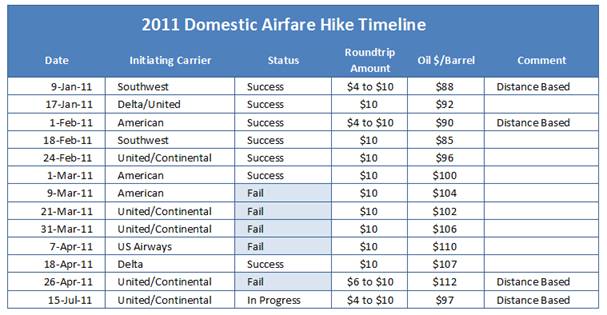
[Chart: Rick Seaney, Farecompare.com]
If it's Friday it might be time for another concerted fare-hike attempt by domestic airlines. Yup, the 13th this year, in which seven so far have been "wildly successful," says Rick Seaney of Farecompare.com, who watches this stuff like a hawk.
United/Continental launched the first domestic airfare hike attempt since late April this morning, he says. "United increased prices by $4 to $10 roundtrip (loosely based on trip distance)," he adds.
However, "fortunately for the domestic air traveling public the new airline economy ushered in by high oil prices in late 2007 requires domestic airlines to fill every middle seat with price sensitive folks – effectively limiting an unchecked rise in ticket prices," Seaney says. So the airlines appear to be biting into fare hikes in small increments instead.
From Seaney:
"I suspect United is probing their competition’s appetite for a lift in ticket prices as airlines have some recent booking demand trend information after launching a couple of fall sales the past few weeks.
"Domestic airlines still have to operate within a competitive equilibrium of never being $1 more or less than their competition (except when they have a convenience advantage) simply because carriers that are $1 more than their competition end up on page 15 of popular comparison shopping sites."
###
U.S. Wants to Require Airlines to Report Fee Revenue in Detail

Trying to get a handle on just how much airlines take in each year in so-called ancillary revenue -- that is, fees added to fares -- the U.S. Transportation Department today proposed a new rule that will require airlines to report more information on the amount and types of fees collected from passengers.
The proposal would revise current reporting requirements "to improve data collection on the amount airlines receive from different, specific types of fees," the department said.
Airlines now submit quarterly reports on revenue from baggage fees and reservation change fees to the DOT’s Bureau of Transportation Statistics. Airlines received $3.4 billion from baggage fees and $2.3 billion from reservation change fees in 2010.
The airlines strongly oppose any move by the government to require them to be more specific in accounting for their various fee revenues.
Here's the gist of the issue:
Last year, the usual suspects in the media were falling over themselves reporting that domestic airlines pocketed $7.8 billion in "ancillary fee" revenue in 2009, according to Transportation Department data. For a year, that was the media benchmark number, endlessly repeated, for defining "fee revenue."
But last month, in the new, long-delayed report on annual ancillary fee revenue for 2010, the Transportation Department switched its procedure and reported the figure for 2010 at $5.7 billion. The usual media suspects rushed to report that, without noting the $2.1 billion discrepancy between the 2009 total and the 2010 total -- at a time when it's well known that ancillary fee revenue has been going up, not down.
The Transportation Department noted that the 2010 figure was just for bags and change fees, underlying its frustration with trying to get the airlines to break down their other fee revenues coherently.
The usual media suspects failed to show any curiosity about the difference between the 2009 and 2010 figures, though. The difference is explained by the fact that the Transportation Department's Bureau of Transportation Statistics had been scrambling, unsuccessfully, to try to find a way to more accurately report the wide range of ancillary fee revenue, not just checked bag fees and itinerary-change penalty fees (which were $5.7 billion in 2010), but the wide array of other fees, like charges for priority seating, in-flight meals, standby status, inflight entertainment and the like.
Adding to the confusion was the fact that the annual reported ancillary-fee number included revenue the airlines make from selling frequent-flier miles to credit card companies for resale to customers. That revenue does not reasonably belong in any useful "ancillary fee" category.
In previous years through 2009, some but not all of those fees were included in the "ancillary fee revenue" total along with the much firmer numbers for checked bags and reservations change penalties -- while other fee data were scattered (to the extent that airlines reported them at all) in different categories such as miscellaneous revenue.
Some estimates by industry analysts put the total actual fee-revenue number for 2010 at over $10 billion, once all of the fees are included, and the number for mileage sales is stripped out (and put in a different category).
"Our goal is to improve the quality of data we collect from airlines and make airline pricing more transparent," Transportation Secretary Ray LaHood said today.
Today’s so-called Notice of Proposed Rulemaking is designed to require airlines to report 16 additional categories of fee revenue in addition to the baggage and reservation change fees.
The department said: "Identification of all ancillary fees and the amounts collected by each airline would improve information available to the public and help determine the impact of the increasing use of these fees on the Airport and Airways Trust Fund. Collection of data on fee revenue was recommended by the Government Accountability Office (GAO) in a July 2010 report."
All of which I have pointed out several times in the recent past, by the way.
###
Thursday, July 14, 2011
Legionnaires Disease Outbreak at Vegas's Aria Hotel

The huge Aria hotel in Las Vegas is telling guests who stayed there between June 21 and July 4 that a "high level of Legionela bacteria" was found "in several of our guest rooms."
In a letter to customers who stayed there during that time, the hotel says it knows of "a few reported instances of people who visited Aria [and] were diagnosed with, treated for, and recovered from Legionnaires disease."
Here's the letter, via VegasTripping.com.
Legionnaires Disease got its name from an outbreak of the disease at the old Bellevue Stratford Hotel in Philadelphia during a convention of American Legion members in July of 1976. That outbreak killed 34 and caused illnesses in hundreds more.
###
###
Subscribe to:
Posts (Atom)
